Brighten & glow in Brickell,
Miami.
Bright, luminous, lit-from-within skin. This is your evidence-based guide to brighten & glow in Brickell: what actually makes skin look radiant versus dull, which treatments deliver it (chemical peels, HydraFacial, IPL and more), what's genuinely effective versus marketing, and how to keep the glow. Book a consultation and we'll build a realistic plan.
Medically reviewed by Mariana Tolosa, PA-C📍 1501 South Miami Avenue #201, Brickell🔬 21 cited sources · peer-reviewed & FDA🗓️ Reviewed 2026
"Glow" is real science — and partly marketing. We treat the science.
Radiant skin isn't a pallor or a color; it's an optical property. A smooth, well-hydrated, even-toned surface reflects light back uniformly and reads as luminous, while a surface roughened by built-up dead cells, dehydration and uneven pigment scatters light and looks grey, flat and tired.2,3 Dullness has identifiable causes — slowed cell turnover, a depleted barrier, sun-induced pigment, and lifestyle factors like poor sleep — so the fix is to treat the cause, not chase a jar of "radiance cream."1,4,16
At Miami Skin Spa in Brickell, our approach to dull skin treatment in Miami is layered: exfoliation to clear the dulling surface (chemical peels, HydraFacial), light-based IPL to even uneven skin tone, microneedling and biostimulators to refine texture and build collagen, and a daily foundation of vitamin C, a retinoid and SPF.6,9,15,18 The honest part: a single facial's glow is largely temporary, more exfoliation is not better, and defined dark spots are their own project — see age spots and hyperpigmentation.
Skin that reflects light
Dermatologists describe radiance as the result of light interacting with the skin. A smooth, uniform surface reflects light evenly and looks luminous; a rough, dead-cell-laden surface scatters it and looks dull. So "brightening" is really about smoothing the surface, evening the tone and keeping the skin hydrated and renewing.2,3
Three biological drivers explain most dullness: cell turnover slows with age (about 20 days in young adults, more than 10 days longer later in life), so dead cells linger and thicken the surface; the stratum corneum holds less water and lipid, so the barrier reflects light poorly; and sun-induced pigment and redness absorb light unevenly.1,5,21 Layer on poor sleep, smoking and pollution and the complexion looks tired.4,16
Every effective "glow" treatment targets one of these levers: exfoliation (peels, hydradermabrasion) removes the dulling dead-cell layer; light and topicals even the tone; microneedling and biostimulators rebuild collagen for a smoother canvas; and hydration plumps the surface so it bounces light back.6,8,9,18
Why "more" backfires
Over-exfoliating strips the barrier's lipids and water, which raises water loss and inflammation — and ironically makes skin look duller and more sensitive. Radiance is about balance, not aggression.5
What's actually dulling your skin
Dead-cell buildup
Turnover slows with age and dead cells linger, thickening the surface so it scatters light instead of reflecting it evenly.
Dehydration & barrier
A dry, lipid-depleted barrier reflects light poorly and looks flat; hydration plumps the surface so it bounces light back.
Uneven tone & sun
Sun-induced brown and red pigment absorbs light unevenly and shadows the complexion — the large majority of visible aging is from UV.
Lifestyle
Poor sleep, smoking, pollution and stress all dull the skin; in one study, sleep-deprived faces were rated less healthy and less attractive.
What's dulling your glow?
Pick what's bothering you and whether you want a quick refresh or a lasting plan. We'll suggest the mix that usually fits best from our menu — and point you to the right hub when defined dark spots are the real issue. This is guidance; your consultation confirms it.6,9
1 · What's dulling your skin?
2 · What are you after?
For tired, flat, dehydrated skin, a HydraFacial's exfoliation-plus-hydration is the classic instant-glow pick, with zero downtime — a favorite before events.
Before a big event? For a wedding, shoot or reunion, a HydraFacial gives an immediate, no-downtime glow — but book it about a week ahead, not the day before, and avoid first-time peels or aggressive treatments right before the date. Lasting radiance is built over weeks, not the night before.8
The glow toolkit
Each tool targets a different lever of radiance — exfoliation, tone, texture, hydration or collagen. Here's how the options we offer line up, plus the at-home actives that do the daily work.6,8,9,18
| Treatment | Type | What it does for glow | Evidence | Downtime |
|---|---|---|---|---|
| HydraFacialHere | Hydradermabrasion (device facial) | Exfoliates dead cells, extracts, hydrates → instant radiance | Moderate · device study; glow is temporary | None |
| Chemical peel (VI / AHA / BHA)Here | Acid exfoliation, superficial–medium | Sheds the dull surface, evens tone & texture over a series | Strong · reviews & RCTs | Flaking ~3–7 days |
| SkinPen microneedlingHere | Collagen-induction microneedling | Refines texture & pores; new collagen → smoother light reflection | Moderate–strong | 1–3 days redness |
| Lumecca IPLHere | Intense pulsed light | Clears sun-induced brown & red tone → clarity | Strong (for tone) | Spots darken then flake |
| SkinVive (HA microdroplets)Here | Intradermal HA "skin booster" | Boosts hydration & smoothness → dewy glow (not exfoliation) | Moderate · FDA RCT | Minimal |
| Sculptra (biostimulator)Here | Collagen-stimulating injectable | Builds collagen over months → firmer, lit-from-within glow | Moderate–strong | Minimal |
| Vitamin C / retinoidAt home | At-home topical actives | Brightens (tyrosinase), antioxidant, raises turnover & collagen | Strong · the at-home foundation | Mild irritation |
HydraFacial vs. chemical peel
A HydraFacial is gentle, hydrating and gives an immediate, no-downtime glow — ideal for maintenance and before events, but largely temporary. A chemical peel resurfaces more deeply for more lasting improvements in tone and texture, with a few days of flaking. Many people use HydraFacials for upkeep between periodic peels.6,8
The at-home foundation
In-office treatments shine when paired with daily actives: a vitamin C antioxidant that inhibits tyrosinase to brighten, a retinoid to speed turnover and build collagen, niacinamide for tone and barrier, and — non-negotiable — daily SPF. These do the steady maintenance work between visits.9,13,15
Instant glow, lasting radiance
Some glow is immediate; the radiance that lasts is built. Here's the realistic arc — and why a one-off facial is a refresh, not a cure for dull skin.8
Three honest myths about glowing skin
More exfoliation = more glow
Over-exfoliating strips the barrier and its lipids, causing redness, sensitivity and — ironically — more dullness. Glow comes from a balanced routine, not daily acids or aggressive scrubbing.
“Detox” teas and drinks brighten skin
There's no good evidence that cleanses or detox drinks brighten skin. Radiance comes from exfoliation, hydration, even tone, collagen and sun protection — not from flushing out “toxins.”
One facial gives permanent glow
A HydraFacial or peel gives a real but largely temporary glow. Lasting radiance needs a plan — a short series plus daily actives and SPF — because skin keeps renewing and aging.
Want real radiance, not just a one-day glow?
Our Brickell team reads what's actually dulling your skin — buildup, dehydration, tone or lifestyle — then builds a layered plan from facials and peels to IPL, microneedling and the right daily actives. No pressure, no overtreatment.
Miami Skin Spa · Brickell · 1501 South Miami Avenue #201, Miami, FL 33129 · 305-557-1615
A rhythm, not a one-off
Radiance is a habit: periodic in-office treatments on a sensible cadence, plus the daily routine that protects and extends them.8,15
Cadence & maintenance
HydraFacials are popular every 4–6 weeks; peels work best as a short series, then occasional upkeep; microneedling is about three sessions. Daily vitamin C, a retinoid and SPF carry the result between visits.8,13
What it costs
Cost depends on the treatment, the area and the number of sessions; facials and peels are often offered as packages or memberships. We give a clear, itemized quote at your consultation — see pricing and real results.
Combination plans
The brightest results layer tools: a peel or HydraFacial for surface, IPL for tone, microneedling or a biostimulator for texture and collagen — sequenced so each builds on the last.9,18,20
Prevention protects the glow
The cheapest brightening step is daily sun protection: in a 4.5-year randomized trial, regular broad-spectrum sunscreen produced 24% less skin aging than discretionary use, and it prevents the uneven tone that dulls skin.15 Add a vitamin C antioxidant by day, a retinoid at night, decent sleep and no smoking, and every in-office treatment works harder.9,13,16
The Miami advantage. Intense year-round sun and humidity make prevention essential — and they shape our choices. In the deeper skin tones common across Miami, exfoliating peels and lasers carry a higher risk of post-inflammatory pigment change, so we favor gentler acids, test patches, pre-treatment prep and diligent SPF; HydraFacial and low-strength peels are generally well tolerated across skin types.7,8
Layered, matched to you
Patients across Miami and Brickell come to us for brightening treatments in Miami — and for uneven skin tone treatment in Miami — that go beyond a single facial. Because we offer the full toolkit — HydraFacial, VI peels, SkinPen, Lumecca IPL, SkinVive and Sculptra — and a licensed aesthetician with 13+ years of experience, we read what's actually dulling your skin, layer the right treatments, and pair them with the daily routine that keeps the glow.
The treatments & related concerns
Before & after
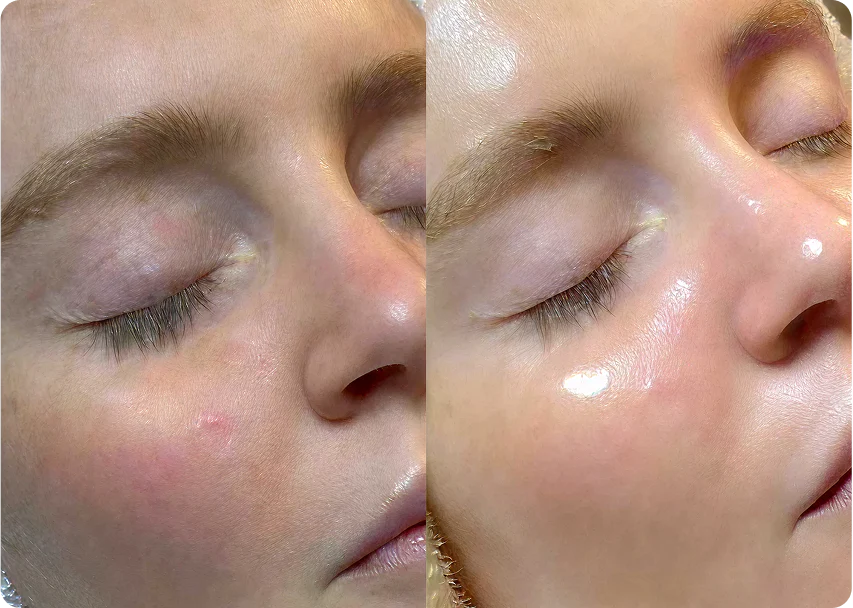 Courtesy of HydraFacial partner gallery
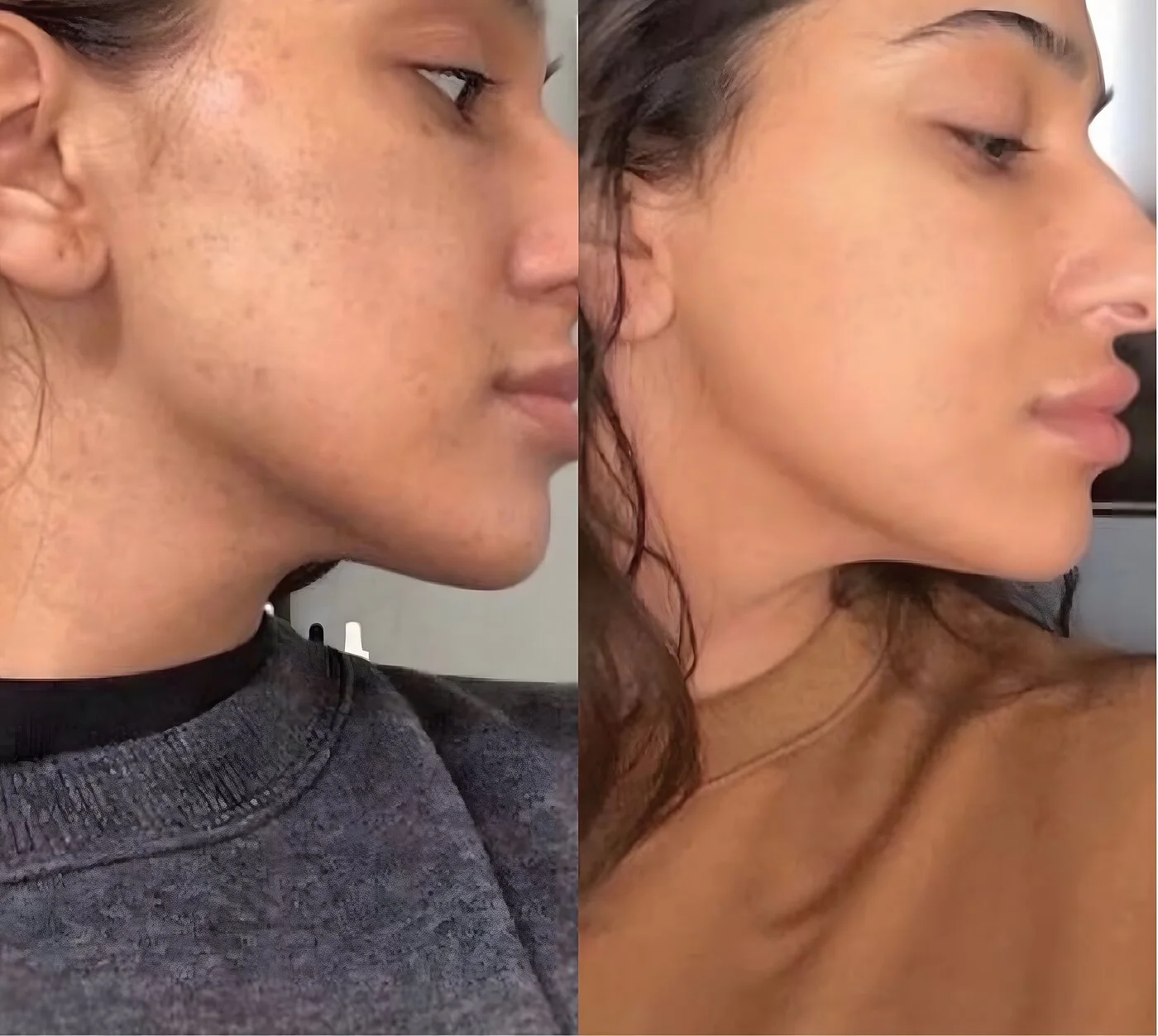 Courtesy of the VI Peel provider network
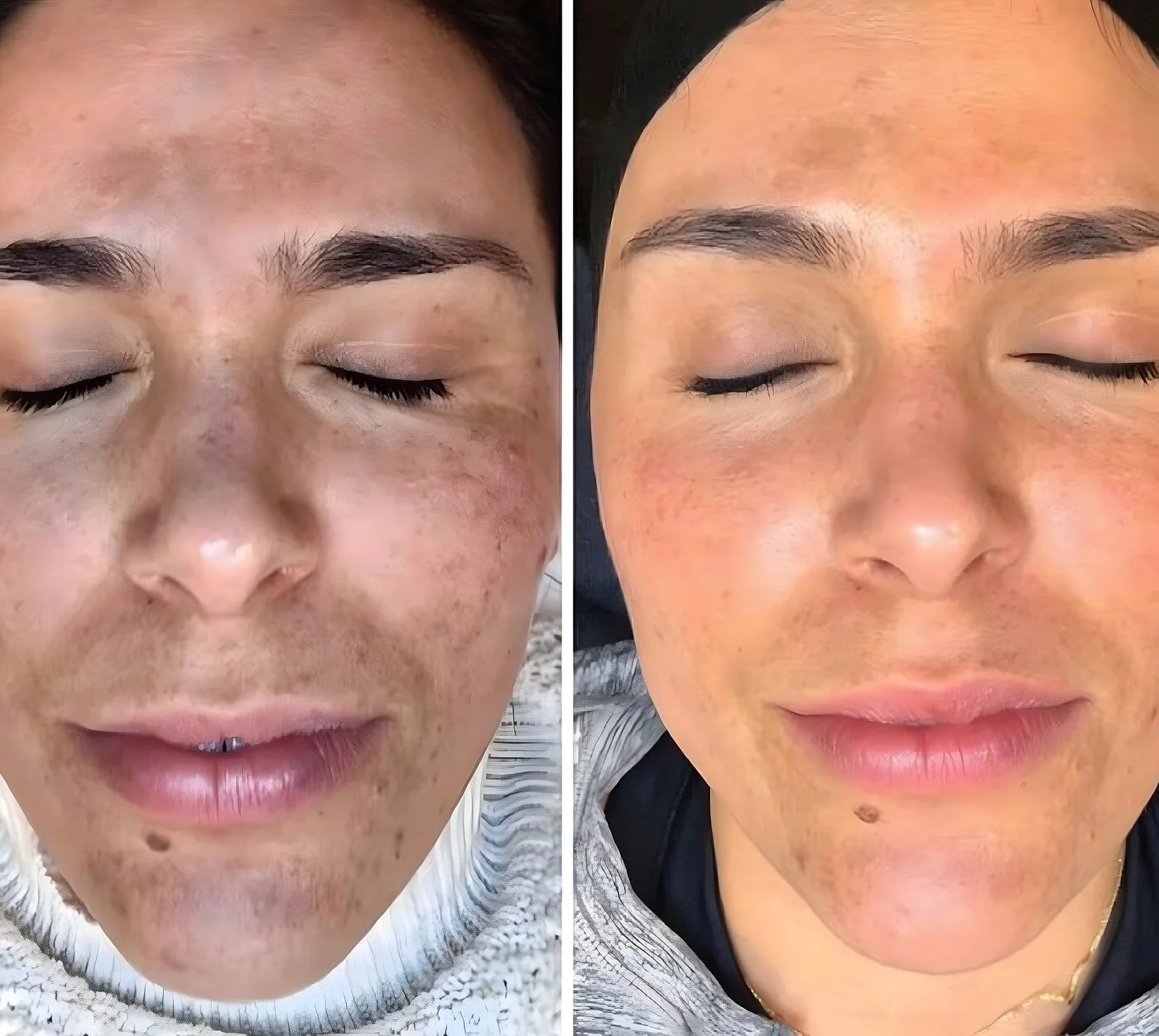 Courtesy of the VI Peel provider network
Frequently asked questions
It depends on what's dulling your skin. For buildup and rough texture, exfoliation with a HydraFacial or chemical peel; for uneven tone, IPL plus vitamin C; for a smoother canvas, microneedling or a biostimulator. Our finder above and a consultation match it to you.6,9
A HydraFacial is gentle and hydrating with an immediate, no-downtime glow — great for maintenance and before events, but temporary. A chemical peel resurfaces more deeply for more lasting tone and texture, with a few days of flaking. Many people alternate: peels periodically, HydraFacials for upkeep.6,8
Yes, the well-studied ones do. Topical vitamin C inhibits tyrosinase and adds antioxidant brightening, retinoids speed turnover and build collagen, and niacinamide helps tone and barrier — they're the daily foundation alongside in-office treatments, with SPF essential. Be skeptical of "miracle radiance" claims without these actives.9,13
Yes, with the right approach. Exfoliating peels and lasers carry a higher risk of post-inflammatory pigmentation in deeper tones, so we use gentler acids, test patches, pre-treatment prep and diligent sun protection. HydraFacial and low-strength peels are generally well tolerated across Fitzpatrick I–VI.7,8
Sources & further reading
Peer-reviewed reviews and trials, clinical-trial data and dermatology references on skin radiance and the optics of dull skin, epidermal turnover, chemical peels, hydradermabrasion, topical vitamin C, niacinamide and retinoids, microneedling, biostimulators, photoprotection and sleep. Where a stable link was available it is included. Links open in a new tab.
- A new method of measurement of epidermal turnover in humans (Cosmetics 2017) — the stratum corneum transit time is about 20 days in young adults and lengthens by more than 10 days in older adults; because UV-induced melanin is shed with dead cells during turnover, a slower rate leaves pigment and dullness visible for longer. https://mdpi.com/2079-9284/4/4/47/htm
- Why do we have a dull complexion? (Typology) — a dull complexion is defined not by pallor but by the skin's reduced capacity to reflect light: radiant skin has a smooth, uniform stratum corneum, whereas accumulated dead cells create an uneven surface that scatters light and looks grey or fatigued; turnover slows and microcirculation declines with age. https://us.typology.com/library/why-do-we-have-a-dull-complexion
- The dermatologist's view of radiance (Dr. Brian Zelickson) — radiance results from light interacting with the skin: the stratum corneum's dead cells absorb light and a buildup looks dull or ashy, while increasing cell turnover (e.g., with retinol) and using in-office lasers and peels yields a more radiant complexion. https://mdcomplete.com/blogs/news/the-dermatologists-solution-for-beautiful-radiance
- Defining skin aging and its risk factors: systematic review & meta-analysis (Sci Rep 2021) — synthesizes modifiable and non-modifiable contributors to visible skin aging, including ultraviolet exposure (the dominant external factor, responsible for a large majority of visible aging), smoking, diet and sleep. https://www.nature.com/articles/s41598-021-01573-z
- Delayed and abnormal epidermal repair in aged skin (PMC) — aging stratum corneum has decreased or altered intercellular lipids and higher trans-epidermal water loss, making the barrier more sensitive to physical or chemical aggression — context for why over-exfoliation worsens, rather than improves, dull, compromised skin. https://www.ncbi.nlm.nih.gov/pmc/articles/PMC4409645/
- Evidence and considerations in the application of chemical peels (J Clin Aesthet Dermatol) — reviews superficial alpha-hydroxy acids (glycolic), beta-hydroxy acids (salicylic), LHA and TCA; superficial peels penetrate the epidermis and are a safe, well-tolerated modality for resurfacing and tone. https://jcadonline.com/evidence-and-considerations-in-the-application-of-chemical-peels-in-skin-disorders-and-aesthetic-resurfacing/
- Glycolic acid peel therapy — a current review (PMC) — alpha-hydroxy acid peels decrease corneocyte cohesion to exfoliate; glycolic peels improve wrinkles, skin tone, texture, radiance and clarity, but combining peels with microdermabrasion can cause post-inflammatory hyperpigmentation in skin types III–VI, so caution is needed in darker skin. https://pmc.ncbi.nlm.nih.gov/articles/PMC3875240/
- Efficacy and tolerability of a HydraFacial clarifying series for active acne (J Clin Aesthet Dermatol 2022) — in patients (Fitzpatrick II–V), LC-OCT imaging showed the stratum corneum thinned from 9.42 to 6.67 µm after a single hydradermabrasion; over six treatments in 12 weeks participants had fewer lesions and clearer, more radiant skin (about 65% rated almost clear). https://jcadonline.com/hydrafacial-treatment-active-acne-vulgaris/
- Efficacy of topical vitamin C in melasma and photoaging: a systematic review (J Cosmet Dermatol 2023) — topical ascorbic acid inhibits tyrosinase and produced significant objective lightening in both melasma and solar lentigines; it supports collagen and elasticity, while observed hydration gains came from regular skincare rather than vitamin C itself. https://onlinelibrary.wiley.com/doi/10.1111/jocd.15748
- Vitamin C in dermatology (review, Clin Dermatol 2026) — L-ascorbic acid is an antioxidant, a collagen-synthesis cofactor and a tyrosinase inhibitor; clinical studies support its role in preventing photoaging, reducing wrinkles and mitigating hyperpigmentation, with formulation/stability the main practical challenge. https://www.sciencedirect.com/science/article/abs/pii/S0738081X26000489
- Ascorbic acid as a safe anti-aging therapy (Antioxidants 2024) — ascorbic acid is an important depigmenting agent through tyrosinase inhibition; a 25% vitamin C formulation significantly reduced melasma pigmentation over 16 weeks, and a vitamin C/E/peptide serum visibly improved skin smoothing, brightening and texture. https://www.mdpi.com/2076-3921/13/2/174
- Topical PDRN, vitamin C and niacinamide via microneedling (PMC) — the combination decreased tyrosinase activity and melanin while increasing type I collagen and elastin in a UV-B model, illustrating niacinamide's and vitamin C's antioxidant, brightening and matrix-supporting roles. https://www.ncbi.nlm.nih.gov/pmc/articles/PMC8879610/
- Topical tretinoin for photoaging: systematic review of RCTs (Int J Womens Dermatol 2022) — retinoids accelerate cell turnover, reduce epidermal melanin and block UV-driven matrix-metalloproteinase damage, improving tone, texture and radiance over time. https://journals.lww.com/ijwd/fulltext/2022/03000/topical_tretinoin_for_treating_photoaging__a.10.aspx
- Restoration of collagen formation in photodamaged skin by tretinoin (Griffiths et al.), N Engl J Med 1993 — landmark trial establishing topical tretinoin's effect on sun-damaged skin. https://www.nejm.org/doi/full/10.1056/NEJM199308193290803
- Sunscreen and Prevention of Skin Aging: A Randomized Trial (Hughes/Nambour), Ann Intern Med 2013 — daily broad-spectrum sunscreen produced 24% less skin aging over 4.5 years versus discretionary use; photoprotection is the single most cost-effective way to preserve radiance. https://pubmed.ncbi.nlm.nih.gov/23732711/
- Beauty sleep: experimental study on perceived health and attractiveness of sleep-deprived people (Axelsson et al.), BMJ 2010 — after sleep deprivation, people were rated by observers as less healthy, less attractive and more tired than when rested, underscoring sleep's visible effect on the face. https://www.bmj.com/content/341/bmj.c6614
- Intense pulsed light for solar lentigines and uneven tone (peer-reviewed) — IPL targets sun-induced brown pigment with high improvement rates and a low rate of post-inflammatory hyperpigmentation, evening overall tone and clarity in photodamaged skin. https://www.researchgate.net/publication/11986342_Intense_pulsed_light_source_for_treatment_of_small_melanocytic_nevi_and_solar_lentigines
- Microneedling / percutaneous collagen induction review (J Cosmet Dermatol 2024) — controlled micro-injury drives neocollagenesis and neoelastogenesis and reduced pore size and trans-epidermal water loss while increasing elasticity, refining texture so the surface reflects light more evenly. https://onlinelibrary.wiley.com/doi/10.1111/jocd.16175
- SKINVIVE by Juvéderm gains FDA approval for cheek skin smoothness (Practical Dermatology 2023) — in the pivotal RCT, 58% and 56% of patients improved cheek smoothness at 1 and 6 months and 63% were satisfied with skin radiance; it improves skin quality through hydration and smoothness rather than exfoliation or volume. https://practicaldermatology.com/news/skinvive-by-juvederm-scores-fda-nod-to-improve-skin-smoothness-in-cheeks/2461717/
- Histology study of injectable poly-L-lactic acid (Sculptra) — evaluates the histologic basis of the skin-quality improvement (radiance, smoothness, pore size) attributed to PLLA-stimulated neocollagenesis, the 'Sculptra glow.' ClinicalTrials.gov NCT04957446. https://clinicaltrials.gov/study/NCT04957446
- What makes skin look dull, by clinical studies (overview) — summarizes three biological drivers identified in dermatology literature: slowed epidermal turnover with dead-cell buildup, decreased stratum-corneum hydration that lowers light reflection, and subclinical inflammation with barrier-lipid depletion, compounded by UV, pollution and lifestyle. https://topicalskin.com/blogs/skincare-news/what-makes-skin-look-dull-according-to-clinical-studies