Hyperpigmentation
treatment in Brickell, Miami.
Clearing dark spots starts with naming them. This is your guide to hyperpigmentation treatment in Brickell, Miami — sun spots, melasma, post-acne marks and freckles each behave differently, so the right treatment depends on the type, how deep the pigment sits, and your skin tone. We'll match a plan from our menu (Pico Genesis, Lumecca IPL, VI Peels and medical-grade skincare), and with melasma the goal is control, not a cure.
Medically reviewed by Mariana Tolosa, PA-C📍 1501 South Miami Avenue #201, Brickell🔬 22 cited sources · peer-reviewed & guidelines🗓️ Reviewed 2026
Pigment is not one problem
Hyperpigmentation simply means too much melanin — but the cause and the depth vary enormously, and that is what determines whether a treatment works.1,5 Sun spots (solar lentigines) are surface, UV-driven pigment that clears well; post-inflammatory hyperpigmentation follows acne or injury and lingers, especially in deeper skin; freckles are benign and sun-driven; and melasma is a chronic, relapsing, hormone- and light-driven condition that often sits deeper and is easily worsened by aggressive treatment.2,3,6
At Miami Skin Spa in Brickell we treat pigment with the tools that fit each case: Pico Genesis and our Enlighten picosecond laser, Lumecca IPL, VI Peels, SkinPen and physician-directed skincare. The heart of good pigment care: every plan is built on daily sun protection, melasma is managed rather than cured, and in deeper skin tones we choose gentler settings to avoid making pigment worse. And because some dark spots can mimic skin cancer, anything new or changing gets evaluated first.8,21
Same color, different causes
All hyperpigmentation comes from extra melanin, made by melanocytes at the base of the epidermis. What matters for treatment is which condition it is and how deep the pigment sits — surface (epidermal) pigment clears far more easily than pigment that has dropped into the dermis.4,5
When UV light, hormones or inflammation switch melanocytes into overdrive, melanin builds up in the skin. If it stays in the epidermis — as in sun spots and many freckles — it sheds and clears relatively well with peels, IPL or a picosecond laser.1,20 But melanin can also drop down and be engulfed by cells in the dermis (melanophages); this dermal pigment, common in melasma and stubborn post-inflammatory marks, clears slowly and resists topical treatment.4,5
That depth difference is why there's no one-size pigment fix. It's also why melasma deserves special care: it's a chronic, relapsing, photoaging-like process, frequently mixed or deep, and prone to coming back — so we treat it gently and continuously rather than chasing fast clearance.3,6
Safety first — rule out skin cancer
Most dark spots are harmless, but a new, changing, asymmetric or unusual spot can be a skin cancer or precursor. Any suspicious lesion is evaluated — and referred for dermatology or biopsy if needed — before any cosmetic treatment.21
The four you'll hear about most
Sun / age spots
Solar lentigines: well-defined brown spots from years of UV exposure on the face, hands and chest — surface pigment that clears well.1,2
Melasma
Larger, blotchy patches driven by hormones, heat and light — often deeper, chronic and relapsing, and easily worsened by aggressive treatment.3,6
Match the pigment to the plan
Pick the kind of pigment you think you have and your skin tone — the second part matters, because deeper skin needs gentler, safer choices. We'll point you to the approach we'd usually take, and flag melasma plainly for caution. This is guidance; an in-person exam confirms it.8,13
1 · What does it look like?
2 · Your skin tone
Sun spots and age spots are surface (epidermal) pigment from UV damage, so they respond well to a picosecond laser or IPL — usually a few sessions — with sun spot removal most effective in fair-to-medium skin. Daily SPF keeps new ones from forming.
The skin-tone dimension
Miami skin spans every Fitzpatrick type. In olive-to-deep skin, melanin is more reactive, so the same laser that safely clears a sun spot on fair skin can trigger post-inflammatory pigment if it's too aggressive — which is why device choice and settings, not just the diagnosis, decide a safe result.3,13
Matched to pigment and skin tone
Here's our pigment toolkit and what each is best for. Pico Genesis and our Enlighten laser handle laser pigmentation removal for sun spots and uneven tone; Lumecca IPL suits surface spots in fairer skin; peels and skincare support every plan. We choose by type, depth and skin tone.15,17,18
| Treatment | Type | Best for | Skin-tone note |
|---|---|---|---|
| Pico Genesis / Enlighten Here | Picosecond laser (532 / 1064 nm) | Sun spots, freckles, PIH, uneven tone; gentle 'toning' for melasma | All skin tones (1064 nm for deeper skin) |
| Lumecca IPL Here | Intense pulsed light | Sun spots, freckles, redness | Best for fair–medium skin; cautious in melasma |
| VI Peel (chemical peel) Here | Medical chemical peel | Surface pigment, PIH, epidermal melasma, tone | Series; depth chosen by skin type |
| SkinPen microneedling Here | Microneedling | PIH and melasma support (with topicals), texture | Gentle; adjunct to a protocol |
| Medical-grade skincare + Rx Here | Topicals (HQ, retinoid, vitamin C, azelaic, tranexamic acid) | The foundation for all pigment — essential for melasma | Daily, ongoing; physician-directed |
Pico Genesis & Enlighten
A picosecond laser delivers ultra-short pulses that shatter pigment with minimal heat, which lowers the risk of post-inflammatory marks — so it works for sun spots, freckles, PIH and tone across skin types, using the gentler 1064 nm for deeper skin.11,13
Lumecca IPL
Intense pulsed light is absorbed by surface melanin and lifts sun spots and freckles (and redness) in fair-to-medium skin; it's used cautiously, or skipped, for melasma and deeper tones where it can backfire.17,19
VI Peel & chemical peels
Medical peels exfoliate pigmented surface cells and speed turnover — useful for epidermal pigment, PIH and tone. Glycolic-type peels help epidermal melasma but not deep melasma, and depth is matched to your skin.4
Control, not a cure
Melasma is a chronic, relapsing condition with no curative treatment — so good melasma treatment in Miami and Brickell is about controlling it gently and protecting against the light and hormones that drive it.6
The evidence-based ladder is consistent. First, photoprotection — rigorous daily broad-spectrum SPF that also blocks visible light, ideally a tinted or iron-oxide sunscreen, because visible light alone can drive melasma and plain sunscreens don't block it.6,9 Then topicals — hydroquinone, azelaic acid, kojic acid, niacinamide, cysteamine and tranexamic acid reduce pigment production.9 For moderate-to-severe cases, oral tranexamic acid has the best evidence among systemic options and meaningfully lowers melasma severity, but it's a clot-risk drug reserved for carefully selected patients.6,7
In-office procedures — gentle low-fluence Pico "toning," mild peels, careful microneedling — are adjuncts, used cautiously and never as a quick fix. Aggressive lasers and IPL can worsen melasma or trigger rebound pigment, particularly in deeper skin.6,8 Even when treatment works beautifully, relapse is common: in studies, pigment that cleared often returned within months without ongoing maintenance.11,12
The evidence-based melasma ladder
1. Daily SPF + visible-light (iron-oxide / tinted) protection — non-negotiable.
2. Topicals: hydroquinone, tranexamic acid, azelaic acid, vitamin C.
3. Oral tranexamic acid for moderate-severe, in select patients.
4. Gentle in-office adjuncts — cautiously.
5. Ongoing maintenance to limit relapse.6,8
Why we won't "blast" it
Trying to erase melasma with an aggressive laser is how people end up worse than they started. We set realistic expectations, protect your result, and keep you in control of it over time.6
Real numbers, plainly framed
For the pigment that clears well — sun spots and benign surface pigment — here's what controlled studies report, including in deeper skin tones. These are real results from real trials, with the necessary caveat that melasma behaves very differently.14,17
Melasma is the exception
Don't read those numbers as melasma numbers. For melasma, adding tranexamic acid lowers severity (a standardized mean mMASI reduction of ~1.84 in trials), but clearance is partial and relapse is common — pigment that cleared with a picosecond laser in one study returned gradually within about nine months.7,11 That's the difference between removing a sun spot and managing melasma.
What pigment clearance looks like
These are clinical and partner-gallery before-and-afters for the treatments we offer — credited to their source, not presented as our own patients. They're representative of what's possible, not a guarantee; outcomes differ from person to person, and melasma results reflect ongoing management.
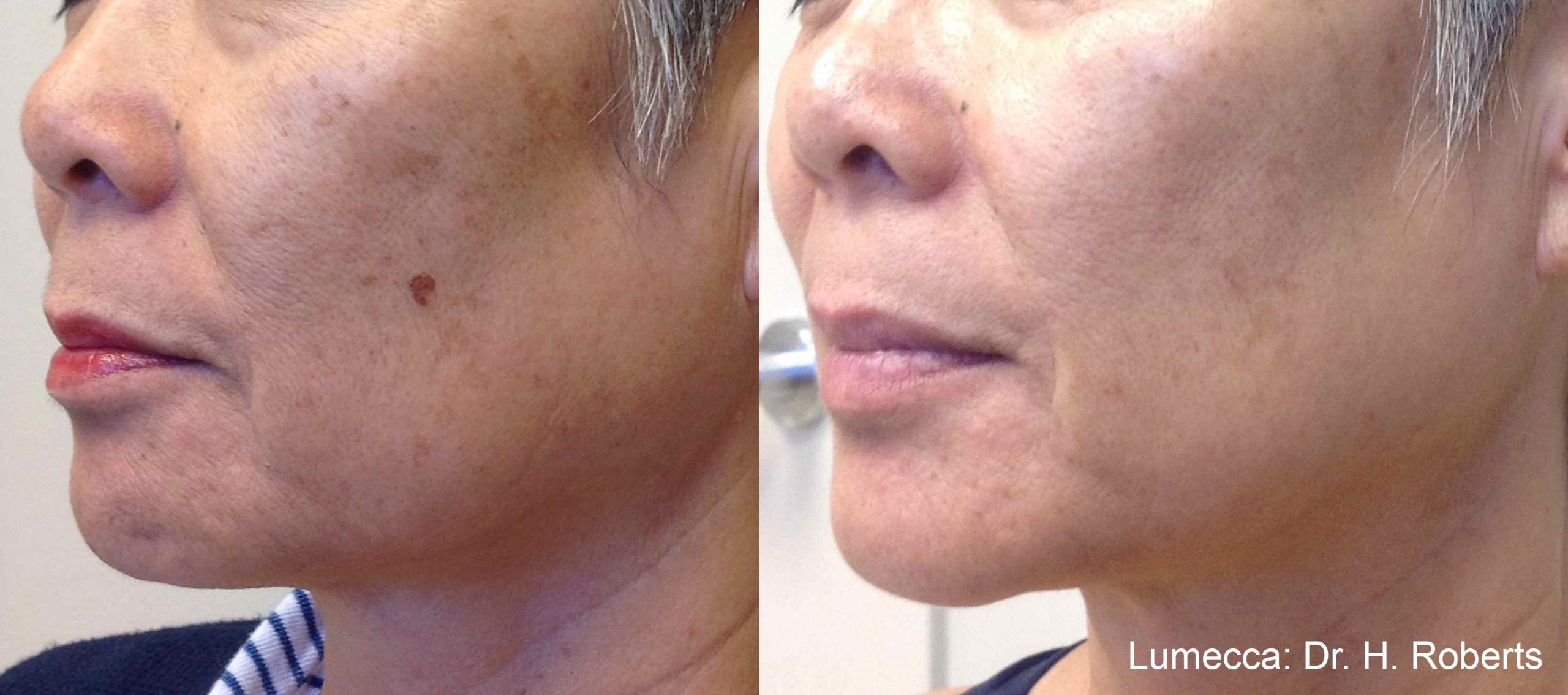 Courtesy of Dr. H. Roberts
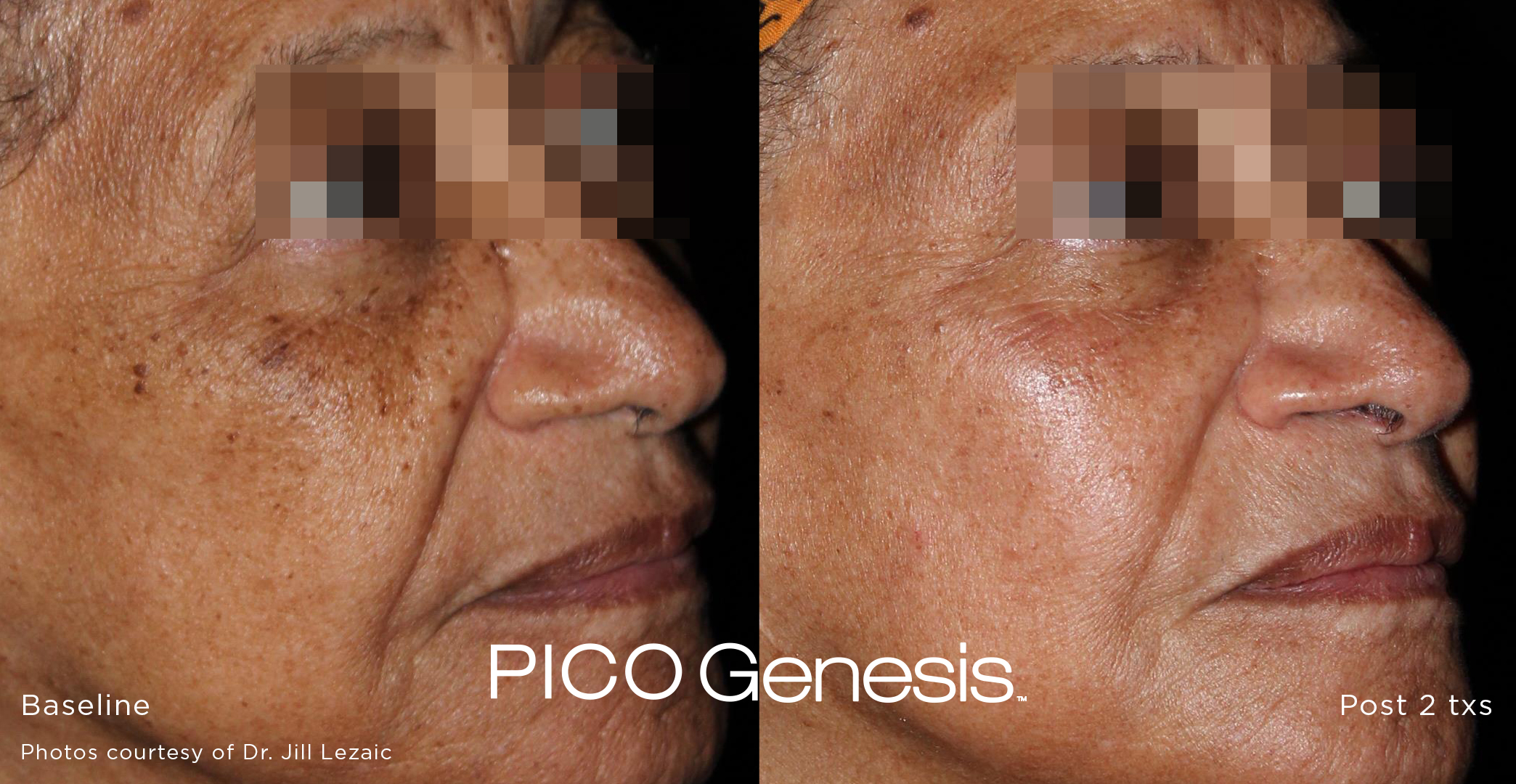 Courtesy of Dr. Jill Lezaic
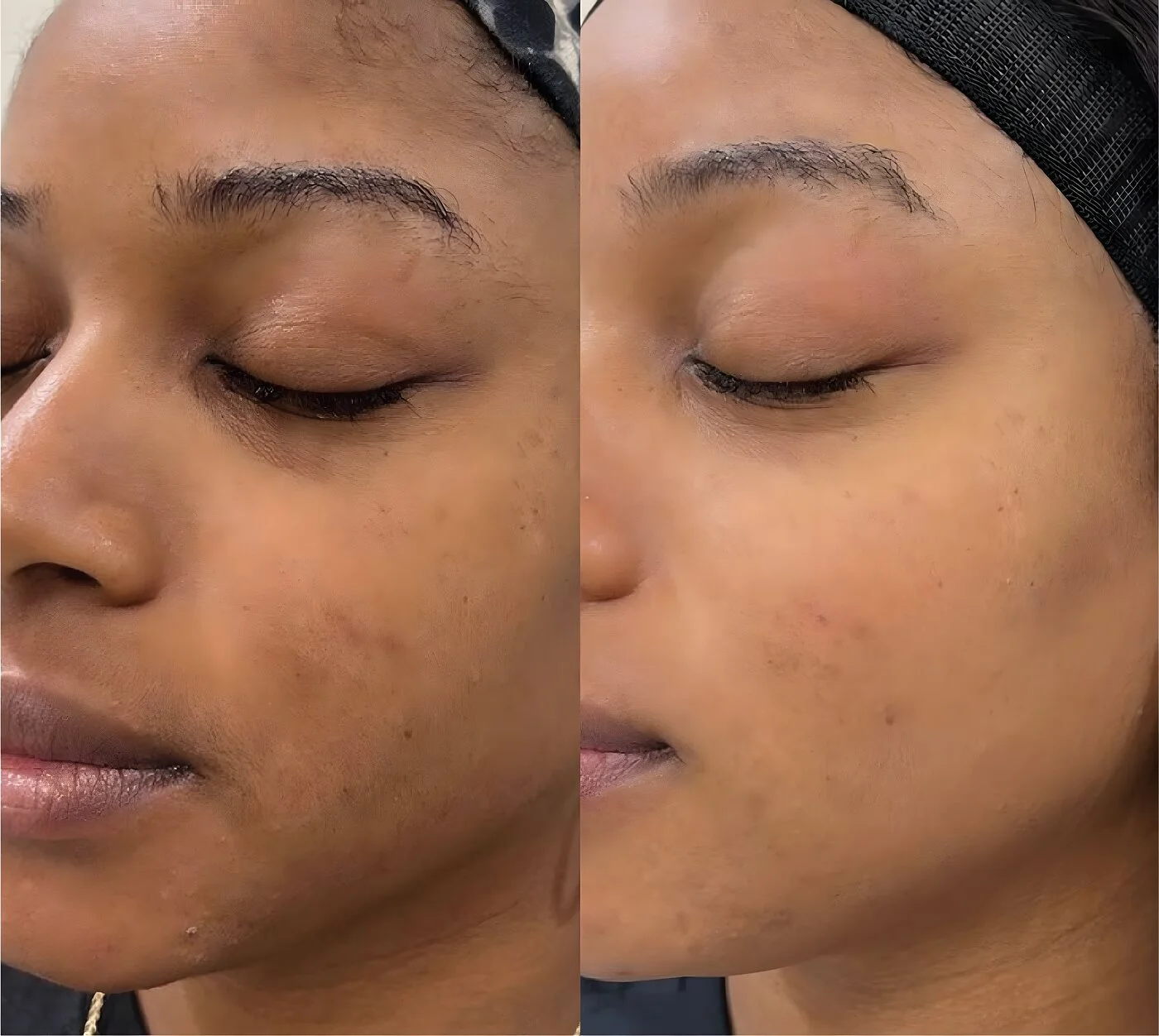 Courtesy of the VI Peel provider network
The first step is a real diagnosis
Our Brickell team identifies exactly what your pigment is — sun damage, melasma or post-inflammatory marks — checks anything suspicious, and builds a plan matched to your skin tone. Realistic expectations, gentle in deeper skin, sun protection at the core.
Miami Skin Spa · Brickell · 1501 South Miami Avenue #201, Miami, FL 33129 · 305-557-1615
Patience, then maintenance
Pigment responds slowly because melanin turns over gradually, and results build over weeks to months. Sun spots can clear in a few sessions; melasma is an ongoing relationship, not a single appointment.3,6
How long to results
Surface sun spots often lift within a few weeks of a session; melasma and prescription topicals generally take three to twelve months to show their benefit, and only with consistent sun protection.10
Safe in every Miami skin tone
Pigment treatment in a diverse city is as much about safety as results. The wrong setting on deeper skin can create the very marks we're trying to clear, so caution and the right device are everything.3,13
Safer choices for deeper skin
In Fitzpatrick IV–VI, melanin is more reactive and PIH is more likely, so we favor picosecond 1064 nm lasers and non-energy options (topicals, gentle peels), keep energy conservative, and avoid aggressive IPL — an approach shown to clear benign pigment safely in deeper skin.13,14
Sun protection is the treatment
Daily broad-spectrum SPF that also blocks visible light — ideally tinted or iron-oxide — isn't optional; it prevents new sun spot formation, limits melasma relapse, and protects every result you pay for.8,9,22
Sessions, maintenance & cost
Hyperpigmentation treatment in Miami is a plan, not a single visit: sun spots may take a few sessions, while melasma needs ongoing maintenance. Cost depends on the treatment, area and number of sessions, usually as packages — we give a clear quote at your consultation.
Diagnosis first, then the right tool
Because we offer Pico Genesis and the Enlighten laser, Lumecca IPL, VI Peels, SkinPen and physician-directed skincare, we can match the treatment to your pigment and skin tone rather than forcing one device on every spot. Our licensed aesthetician Amy Betancourt, MA brings 13+ years with pico, peels and facials, and our medical team — Mariana Tolosa, PA-C; Morgan Winters, FNP-C; and Jasmine Vazquez-Mack, APRN-C — directs prescription topicals and evaluates any spot that needs a closer look.
Explore the treatments & related concerns
Frequently asked questions
There's no single best — it depends on the type and your skin tone. Sun spots and freckles respond well to Pico Genesis or IPL; post-acne marks fade with topicals and gentle treatment; and melasma treatment is about control — sun protection and topicals first, with only gentle in-office adjuncts. A consultation identifies which you have.1,6
Cautiously, and never as a cure. Aggressive lasers and IPL can worsen melasma or trigger rebound pigment, especially in deeper skin, so they're avoided; only gentle, low-fluence approaches are used as adjuncts alongside daily sun protection and prescription topicals. Melasma is chronic and relapsing, so the goal is long-term control.6,8,13
Yes, for surface pigment. Medical peels exfoliate pigmented epidermal cells and speed turnover, helping sun spots, some post-inflammatory marks and epidermal melasma; glycolic-type peels help epidermal melasma but not deep (dermal) melasma. A series plus daily sun protection gives the best dark spot treatment results.4
Conservative, skin-type-aware choices. Picosecond lasers (especially 1064 nm) and non-energy options like topicals and gentle peels are safer in Fitzpatrick IV–VI, where aggressive IPL and high-energy lasers carry a higher risk of post-inflammatory pigment. Settings are always tailored — studies show benign pigment can be cleared safely in deeper skin this way.13,14,3
Sources & further reading
Peer-reviewed reviews, clinical trials and clinical guidelines on pigmentary disorders — the biology and types of hyperpigmentation, melasma evaluation and management (photoprotection, topicals, tranexamic acid), picosecond and Q-switched lasers including in skin of color, intense pulsed light for solar lentigines, chemical peels, and the importance of excluding skin cancer. Where a stable link was available it is included. Links open in a new tab.
- Pigmentation disorders: diagnosis and management. Am Fam Physician, 2017. https://www.aafp.org/pubs/afp/issues/2017/1215/p797.html
- Differential diagnosis of melasma and hyperpigmentation. Dermatological Reviews, 2023. https://onlinelibrary.wiley.com/doi/full/10.1002/der2.144
- Understanding hyperpigmentation: etiology, patient impact and evolving clinical challenges. Masterclasses in Dermatology. https://www.hmpglobalevents.com/article/understanding-hyperpigmentation-etiology-patient-impact-and-evolving-clinical-challenges
- Postinflammatory hyperpigmentation: review of pathogenesis and treatment. Pigment International, 2014. https://journals.lww.com/pigi/fulltext/2014/01020/postinflammatory_hyperpigmentation__review_of.5.aspx
- Hyperpigmentation — an overview. Medscape/CME review. https://www.medscape.com/viewarticle/493946
- Update on melasma, Part II — treatment. Dermatol Ther, 2022. https://link.springer.com/article/10.1007/s13555-022-00780-4
- Tranexamic acid for melasma: meta-analysis of randomized controlled trials. J Dermatolog Treat, 2024. https://www.tandfonline.com/doi/full/10.1080/09546634.2024.2361106
- Management of melanin hyperpigmentation: global guideline summary. 2025/2026. https://reference.medscape.com/cc2/p10/management-melanin-hyperpigmentation-disorders-guideline-2026a10009av
- Melasma: what are the best treatments? Harvard Health, 2022. https://www.health.harvard.edu/blog/melasma-what-are-the-best-treatments-202207112776
- Melasma: diagnosis and treatment. American Academy of Dermatology. https://www.aad.org/public/diseases/a-z/melasma-treatment
- Picosecond 755-nm alexandrite laser with topical JAK inhibition for melasma. J Cosmet Dermatol case report, 2025. https://www.ncbi.nlm.nih.gov/pmc/articles/PMC12498491/
- Topical tranexamic acid alone or with fractional CO2 laser or microneedling for melasma. PMC10412040. https://pmc.ncbi.nlm.nih.gov/articles/PMC10412040/
- Low-fluence picosecond 1064-nm vs 532-nm Nd:YAG for pigmented lesions. Cosmetics (MDPI), 2024. https://www.mdpi.com/2079-9284/11/3/89
- Q-switched 1064/532-nm Nd:YAG for benign hypermelanosis in dark-skinned individuals (Fitzpatrick IV–VI, n=30). J Clin Med (MDPI), 2024. https://www.ncbi.nlm.nih.gov/pmc/articles/PMC10971304/
- 755-nm picosecond and Q-switched lasers for pigmentary disorders in skin of color. PubMed 26922302. https://pubmed.ncbi.nlm.nih.gov/26922302/
- Fractional 1064-nm picosecond Nd:YAG for Asian skin. PMC12014787. https://www.ncbi.nlm.nih.gov/pmc/articles/PMC12014787/
- Intense pulsed light for solar lentigines of the hands (n=31, 515-nm filter, up to 5 sessions). PubMed 22515674. https://pubmed.ncbi.nlm.nih.gov/22515674/
- IPL for pigmented lesions: systematic review. J Cosmet Dermatol, 2024. https://onlinelibrary.wiley.com/doi/full/10.1111/jocd.16285
- Current trends in intense pulsed light. J Clin Aesthet Dermatol. https://jcadonline.com/current-trends-in-intense-pulsed-light/
- Videomicroscopic and histopathologic study of IPL for solar lentigines. PubMed 12088609. https://pubmed.ncbi.nlm.nih.gov/12088609/
- Common pigmentation disorders. Am Fam Physician, 2009. https://www.aafp.org/pubs/afp/issues/2009/0115/p109.html
- An updated review of melasma treatments. Dermatology Advisor, 2025. https://www.dermatologyadvisor.com/features/updated-review-of-melasma-treatments/