Dark spots in Brickell,
Miami.
Not every dark spot is the same — and that decides how to treat it. This is your decision hub for dark spot treatment in Miami and Brickell: how sun spots, age spots, freckles and flat post-acne marks differ, which actually clear with IPL, picosecond laser or peels, and the cases where — plainly — a spot needs a doctor first. Whether you want sun spot removal, dark spot removal or just an even, brighter complexion, book a consultation and we'll map it.
Medically reviewed by Mariana Tolosa, PA-C📍 1501 South Miami Avenue #201, Brickell🔬 22 cited sources · peer-reviewed & FDA🗓️ Reviewed 2026
Same color, different problems
"Dark spots" is a catch-all for several different things, and lumping them together is why so much treatment disappoints. Flat brown sun spots and age spots (solar lentigines) are sun-driven and the most treatable with light and laser. Freckles are genetic and fade back with the seasons. Post-acne and post-injury marks are pigment left behind by inflammation, not scars. And mask-like melasma is a chronic, hormone- and heat-driven condition that can actually worsen with aggressive laser.8,14,15
At Miami Skin Spa in Brickell we start by naming what you actually have, then match the tool — Lumecca IPL and picosecond laser for sun and age spots, prescription brightening topicals and gentle peels for post-acne marks, and a deliberately conservative, topical-led plan for melasma. Two principles run through all of it: pigment depth and skin tone decide the safe choice, and daily broad-spectrum sun protection is the treatment that never ends.1,21 The most important rule of all comes first — a spot that is new, changing or unusual gets checked by a doctor before anything else.19,20
Melanin in the wrong place
Dark spots are clusters of extra melanin, the pigment made by melanocytes in the base of the epidermis. Ultraviolet light — and, it turns out, visible light too — switches those cells into overdrive, and the pigment they make either sits near the surface or settles deeper. Where it lands is what makes a spot easy or hard to treat.8,21
When light hits the skin, melanocytes pump out melanin and hand it off to surrounding skin cells as a built-in sunshade. Over years, repeated UV exposure makes that response patchy and permanent — discrete solar lentigines, the dark spots on the face and hands we call sun spots, age spots or liver spots.1 Inflammation does something similar: after a breakout or injury, the skin can leave a flat brown mark called post-inflammatory hyperpigmentation.8
Depth is the dividing line. Epidermal pigment near the surface responds well to topicals, peels and light-based treatments that lift it away. Dermal pigment that has settled deeper is far more stubborn and resists creams entirely — which is why a dermatologist often uses a Wood's lamp to judge how deep the color goes before choosing a treatment.8,12,17 Visible light from the sun (and screens) also drives pigment, especially in melanin-rich skin, so protection has to cover more than UV alone.21
What kind of dark spot is it?
Pick the kind of spot and your skin tone. We'll point to the approach that usually fits best from our menu — and flag when a spot is really melasma, or when it needs a doctor's eye first. This is guidance; your consultation confirms the plan.1,8
Safety first
Any spot that is new, growing, changing color or shape, has irregular borders, itches or bleeds should be evaluated by a dermatologist before any cosmetic treatment. A flat brown spot can occasionally be an early melanoma, and treating an undiagnosed lesion can hide it.19,20 When in doubt, we refer you out first.
1 · What does the spot look like?
2 · Your skin tone
On olive skin, sun and age spots clear with a picosecond laser or carefully dialed IPL — we choose gentler settings, and sometimes a deeper-reaching 1064 nm wavelength, to lower the chance of a temporary dark mark. A test spot guides the plan.
Skin tone changes the safe choice. In fair skin, broadband IPL is a workhorse for sun and age spots. In medium and especially deep, melanin-rich skin, IPL is often avoided — it can burn or trigger new dark marks — and we lean on a 1064 nm picosecond laser, gentle peels and prescription topicals instead, always with a test spot.6,7 Brickell's diverse skin is exactly why one-size-fits-all pigment treatment fails.
Name it before you treat it
Most facial brown spots fall into four buckets. Telling them apart is the whole game, because the right treatment for one is the wrong treatment for another.1,8,14
Sun spots & age spots
Flat, well-defined tan-to-brown macules from years of UV. Benign, the most treatable with light and laser — but a new or changing one should always be checked.
Most treatableFreckles
Small genetic, sun-darkened spots that fade in winter. Lasers lighten them, but they return with sun, so protection is the real control.
Returns with sunPost-acne / injury marks
Flat brown marks where a pimple or injury healed — pigment, not a scar. Topicals and peels lead; lasers are cautious, especially in deeper skin.
Topical-ledMask-like patches
Diffuse, symmetrical patches driven by hormones, heat and light. Chronic, often deeper, and laser can worsen it — treated on our hyperpigmentation hub.
Treated differentlyTwo spots that aren't "just" dark spots. A raised, rough, waxy or "stuck-on" brown growth is usually a seborrheic keratosis — benign, but a different removal, and best confirmed by a clinician. And a new, changing or irregular spot — especially one appearing after age 60, or with mixed colors and uneven borders — must be checked to rule out skin cancer before any laser.19,20 We assess every spot before treating it.
From light to topicals
For sun spot removal and age spots, light and laser do the heavy lifting; for post-acne marks, prescription topicals lead. Here's the toolkit we actually offer, and how the treatments line up — with depth and skin tone deciding the safe pick.1,8,12
Lumecca IPL
Broadband intense pulsed light is absorbed by surface pigment, which darkens and flakes away. It's a workhorse for sun spots, age spots and brown spots on fair-to-medium skin — across trials, IPL cleared solar lentigines in roughly 75–90% of cases.1 Avoided on tanned or deep skin, where it can cause marks.
Picosecond & Q-switched laser
Our Enlighten picosecond/nanosecond laser delivers ultra-short pulses that shatter pigment with little heat. Picosecond devices clear solar lentigines in about 68–93% of cases, and a 1064 nm wavelength lets us treat discrete spots safely in deeper skin tones.1,7
Pico Genesis
A picosecond laser facial that targets overall dullness, scattered brown and uneven tone rather than one spot — gentle, with minimal downtime, and a good fit for an all-over brightening plan, including for many medium and deeper tones.7
Chemical peels (VI / salicylic)
A series of peels exfoliates pigmented surface cells and is especially useful for post-acne marks and epidermal brown; a salicylic peel paired with a topical retinoid outperformed either one alone.12 Kept superficial in deeper skin.
SkinPen microneedling
Micro-channels can deliver brightening serums and support an even tone, and microneedling carries a low pigment risk across skin tones — a useful adjunct for stubborn post-acne marks alongside topicals.10,13
Medical-grade topicals (Rx)
The foundation. Tyrosinase inhibitors — azelaic acid, retinoids, vitamin C, cysteamine, tranexamic acid and provider-guided hydroquinone — slow melanin and fade marks; hydroquinone is the long-standing gold standard but is prescription-only and used in supervised courses.8,9,10
| Treatment | How it works | Best for | Skin-tone fit | Downtime | Sessions |
|---|---|---|---|---|---|
| Lumecca IPLHere | Broadband light absorbed by surface pigment | Sun spots, freckles, brown spots | Fitz I–III; avoided on tanned or deep skin | Spots darken then flake, 3–7 days | 1–3 |
| Pico / Q-switched laser (Enlighten)Here | Ultra-short pulses shatter pigment | Discrete sun & age spots; all tones at 1064 nm | All tones with wavelength/energy tailored | Tiny darkening or crust, a few days | 1–3 |
| Pico GenesisHere | Picosecond laser facial for overall tone | Diffuse dullness, scattered brown, mild marks | Most tones; conservative in deep skin | Minimal, mild redness | 2–4 |
| Chemical peel (VI / salicylic)Here | Exfoliates pigmented surface cells | Epidermal brown, post-acne marks, glow | Most tones; kept superficial in deep skin | Light flaking, 2–5 days | Series |
| SkinPen microneedlingHere | Micro-channels deliver brightening serums | Post-acne marks adjunct, texture | All tones; low pigment risk | Redness 1–2 days | Series |
| Medical-grade topicals (Rx)Here | Tyrosinase inhibitors slow melanin | Marks, melasma, maintenance — the foundation | All tones; provider-guided | None | Daily, ongoing |
What the trials show for sun spots
A 2024 systematic review of 41 trials pooled how well different treatments clear solar lentigines — the classic sun spot. Light and laser lead, topicals help, and results vary widely by device, protocol and skin type. These are reported ranges, not a head-to-head race — and none of them apply to melasma.1
What's realistic
For true sun and age spots, expect meaningful clearing — often dramatic after one to three sessions — with picosecond series reporting ~90% of patients achieving ≥95% lesion reduction at six months in one study.2,3 Post-acne marks fade more gradually over weeks to months with topicals and peels.8
Never laser an unknown spot
A flat brown mark can occasionally be an early melanoma (lentigo maligna) that mimics a harmless sun spot — and treating it cosmetically can delay the diagnosis. In one study of biopsy-proven lentigo maligna, 7.4% of patients had already had cosmetic treatment, which obscured the lesion's borders and delayed care.19,20
The ABCDEs — when to get a spot checked
Recently tanned?
Light and laser on freshly tanned skin risks burns and patchy pigment. We wait until a tan fades and time treatment for lower-sun stretches.6
Deeper skin tones
Melanin-rich skin is more prone to post-treatment dark marks, so we favor 1064 nm laser, conservative settings, peels and topicals — and test before we treat.6,7
Looks like melasma?
A diffuse, symmetrical mask that flares with sun or heat is treated topical-first on our hyperpigmentation hub — aggressive laser can worsen it.15
Spots darken, then lift away
After a light or laser treatment, sun spots typically look darker for a few days, then crust and flake off as the skin renews. Most plans run a short series — and then sun protection keeps the results.1,3
The treatment that never ends
Daily broad-spectrum SPF is non-negotiable, and for pigment-prone or deeper skin a tinted mineral sunscreen with iron oxides matters: ordinary mineral filters don't block visible light, but iron-oxide tints do, and they help prevent both new sun spots and pigment relapse.21,22 It's the single highest-value step in any dark-spot plan.
Not sure what your spots are? Start with an assessment.
Our Brickell team identifies what kind of dark spots you have, checks anything that needs a doctor's eye, and builds a plan matched to your skin tone — light, laser, peels, topicals, or a referral if a spot should be seen first.
Miami Skin Spa · Brickell · 1501 South Miami Avenue #201, Miami, FL 33129 · 305-557-1615
A plan, not a single zap
Dark spot treatment in Brickell works best as a short, layered plan — clear the pigment, support the skin, and protect against the next wave.1,16
Sessions & maintenance
Sun and age spots often clear in 1–3 light or laser sessions; post-acne marks fade over a series of peels and daily topicals across 2–3 months. A periodic touch-up plus SPF keeps things even as new sun exposure adds up.1,8
The Miami skin-tone advantage
Miami and Brickell skin spans every Fitzpatrick type, and pigment behaves differently across that range. Because we run a full menu — IPL, picosecond laser, Pico Genesis, peels, microneedling and medical-grade topicals — we can choose the pigment-safe tool for your skin rather than forcing one device, and we test before treating deeper tones.6,7
The full menu, matched to you
Patients across Miami and Brickell come to us for dark spot removal because we don't sell a single device. Our team — including aesthetician Amy Betancourt, with 13+ years in facials, peels and Pico — assesses your skin, names what you have, and recommends what fits, combining treatments when it helps and referring out when a spot should be seen by a physician.
Explore the treatments & related concerns
Before & after
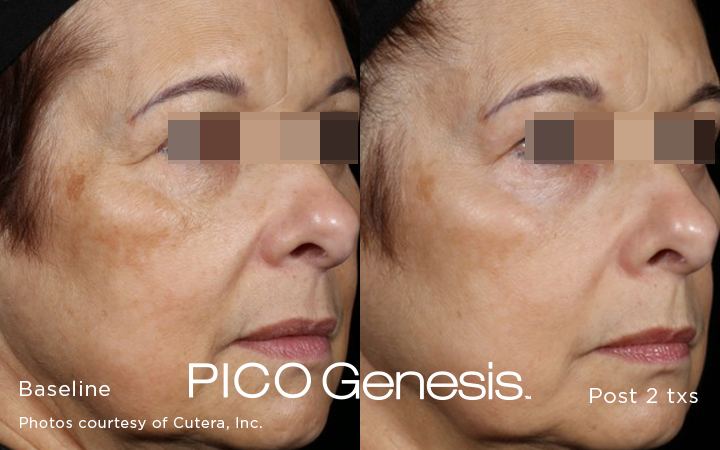 Courtesy of Dr. Jill Lezaic
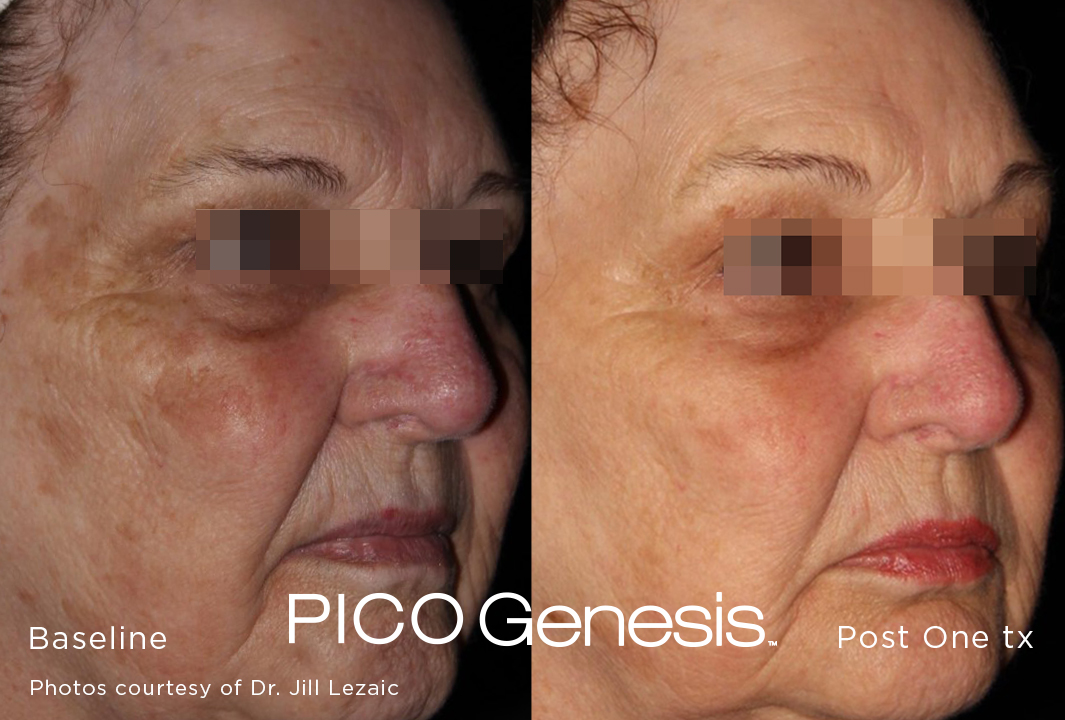 Courtesy of Dr. Jill Lezaic
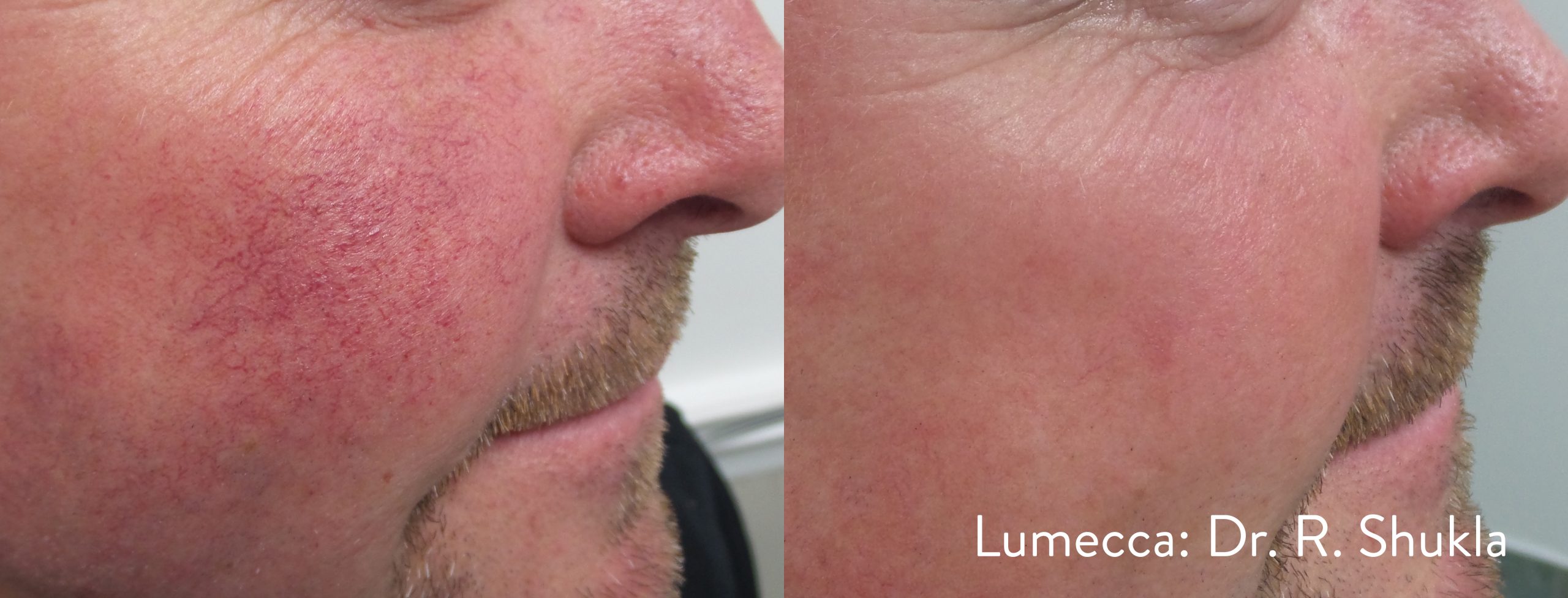 Courtesy of Dr. R. Shukla
Frequently asked questions
There's no single best — it depends on the spot. Flat sun spots and age spots clear best with IPL or a picosecond laser; post-acne marks respond to prescription topicals and gentle peels; and mask-like melasma is treated topical-first on our hyperpigmentation hub. Our decision tool above and a consultation match the right dark spot treatment in Miami to your skin and tone.1,8
Yes — sun spots and age spots (solar lentigines) are the most treatable dark spots. Across clinical trials, IPL cleared them in about 75–90% of cases and picosecond lasers in roughly 68–93%, often with dramatic improvement in one to three sessions.1,3 "Removal" is realistic for these, though new spots can form later without sun protection.
It depends on your skin tone and the spot. IPL is excellent for sun and age spots on fair-to-medium skin but is usually avoided on tanned or deep skin. A picosecond laser is more precise and, at a 1064 nm wavelength, can treat discrete spots more safely in darker tones.1,6,7 We choose based on a skin assessment, often with a test spot.
Treated spots are gone, but the skin keeps making pigment, so sun and visible light can create new spots over time. Daily broad-spectrum SPF — ideally a tinted mineral sunscreen with iron oxides — is what keeps results, and it's the most important step in any plan.21,22 Freckles in particular tend to return with sun.
For surface (epidermal) pigment and post-acne marks, yes — a series of peels exfoliates pigmented cells and brightens, and a salicylic peel with a topical retinoid worked better than either alone.12 Peels are less effective for deep pigment, and in darker skin we keep them superficial to avoid triggering new marks.
Yes, with the right choices. We favor a 1064 nm picosecond laser, conservative peels and prescription topicals and avoid broadband IPL, which can burn or cause post-inflammatory dark marks in melanin-rich skin.6,7 Because Miami and Brickell skin is so diverse, we always assess skin type and test before treating.
A diffuse, symmetrical, mask-like patch that darkens with sun or heat is likely melasma, which we treat differently on our hyperpigmentation hub. More importantly, any spot that is new, growing, has irregular borders or mixed colors, or itches or bleeds should be checked by a dermatologist before any cosmetic treatment — a flat brown spot can occasionally be an early melanoma.19,20 We refer out anything suspicious first.
Sources & further reading
Peer-reviewed reviews and clinical trials, systematic reviews and meta-analyses, clinical-trial records, and device and photoprotection literature on dark spots, sun spots, post-inflammatory hyperpigmentation, melasma and pigmented-lesion safety. Where a stable link was available it is included. Links open in a new tab.
- Treatment of solar lentigines — systematic review of 41 clinical trials (3,234 patients): reported success by modality — IPL 74.6–90%, picosecond laser 67.9–93.0%, Q-switched laser 36.4–76.6%, fractional CO2 8–23%, pulsed-dye 27–57%, TCA peel 12–46%, cryotherapy 37–71.4%; best topical mequinol 2% + tretinoin 0.01% (52.6–>80%). 2024. https://pmc.ncbi.nlm.nih.gov/articles/PMC11948172/
- Effectiveness of 730 nm picosecond laser for freckles and solar lentigines (retrospective, FST III–IV): high clearance, low recurrence, ~86% satisfaction; PIH in only 2 patients. 2023. https://onlinelibrary.wiley.com/doi/10.1155/2023/2070560
- Picosecond lasers for non-tattoo skin lesions — comprehensive review: 730 nm series produced lesion clearance of 53.1% after one session and 78.4% after two; ~90% of patients had ≥95% reduction at 6 months. 2025. https://www.mdpi.com/2076-3417/15/9/4719
- Cutera picosecond Q-switched Nd:YAG (1064/532 nm) for benign pigmented lesions — clinical study of age (sun) spots on the hands. ClinicalTrials.gov NCT01885871 (sponsor: Cutera Inc.). https://clinicaltrials.gov/study/NCT01885871
- 730-nm, 532-nm and 694-nm laser for freckles and solar lentigines — randomized split-face trial: all three are effective; the 730-nm picosecond laser showed the least basal-cell injury (best safety). 2025. https://link.springer.com/article/10.1007/s10103-025-04562-0
- Long-pulsed alexandrite laser for solar lentigines — notes that Q-switched lasers carry a higher risk of post-inflammatory hyperpigmentation (PIH) in darker skin types. Turkderm 2023. https://doi.org/10.4274/turkderm.galenos.2023.21855
- Picosecond 532 nm vs low-fluence 1064 nm Nd:YAG in Fitzpatrick III–VI — comparable facial pigment clearance; the 1064 nm wavelength penetrates deeper with a favorable safety profile in skin of color. Cosmetics 2024. https://doaj.org/article/d139a099a97a4653a526e2a2b204ab67
- Post-inflammatory hyperpigmentation in skin of color — review: first-line is topical tyrosinase inhibitors (hydroquinone, azelaic acid, kojic acid, retinoids, vitamin C) plus photoprotection; topicals work on epidermal pigment, while deeper dermal pigment responds poorly. JCAD 2018. https://jcadonline.com/postinflammatory-hyperpigmentation-a-review-of-the-epidemiology-clinical-features-and-treatment-options-in-skin-of-color/
- Topical hydroquinone for hyperpigmentation — narrative review: long the gold-standard depigmenting agent for lentigines, PIH and melasma; not approved for OTC use in the US and restricted abroad; long-term overuse risks ochronosis, so it is provider-guided. 2023. https://www.ncbi.nlm.nih.gov/pmc/articles/PMC10723018/
- Post-inflammatory hyperpigmentation in skin of color — emerging therapies and treatment algorithms: hydroquinone, retinoids, azelaic acid, cysteamine and tranexamic acid remain first-line alongside photoprotection. Cureus 2026. https://www.cureus.com/articles/474291-post-inflammatory-hyperpigmentation-in-skin-of-color-emerging-therapies-and-treatment-algorithms
- Acne-related PIH in skin of color — azelaic acid 15% gel twice daily over 16 weeks gave statistically significant improvement, with over half of participants clear of PIH; retinoids and triple-combination cream also effective. JCAD. https://jcadonline.com/acne-post-inflammatory-hyperpigmentation-skin-of-color/
- Postinflammatory hyperpigmentation — clinical overview: topical agents treat epidermal PIH only; a combination of a salicylic-acid peel plus topical tretinoin outperformed either treatment alone. Medscape/eMedicine. https://emedicine.medscape.com/article/1069191-overview
- Treatment of PIH in skin of color — systematic review: PIH is chronic once established and harder to treat in darker skin; topicals (retinoids, tranexamic acid, hydroquinone) plus light/laser used cautiously. 2024. https://www.ncbi.nlm.nih.gov/pmc/articles/PMC11514325/
- Melasma — step-by-step multimodal therapy: consistent photoprotection plus melanin-synthesis-inhibiting topicals are first-line; safer tyrosinase inhibitors (thiamidol, tranexamic acid) are now preferred; melasma is persistent and recurring. 2024. https://pmc.ncbi.nlm.nih.gov/articles/PMC11128260/
- Low-fluence Q-switched Nd:YAG for melasma — systematic review: results inconsistent, with recurrence and even worsening not uncommon; laser is relatively contraindicated for melasma because heat can stimulate melanogenesis, especially in darker skin. 2022. https://www.ncbi.nlm.nih.gov/pmc/articles/PMC9323185/
- Comparison of melasma treatments — network meta-analysis of RCTs: first-line is topical therapy for ≥3 months; chemical peels are second-line; laser/light devices are third-line add-ons. No single treatment is uniformly effective. 2021. https://www.ncbi.nlm.nih.gov/pmc/articles/PMC8511390/
- Melasma — national dermatologist survey: topical therapy was first-line for 95%; the most common recurrence rate reported was 41–60%; mixed-type melasma was most common; Wood's lamp used to gauge pigment depth. 2025. https://www.ncbi.nlm.nih.gov/pmc/articles/PMC11743328/
- Non-ablative fractional laser plus topical tranexamic acid for melasma — randomized split-face trial: significant short-term improvement, but significant recurrence in both arms during follow-up. 2025. https://www.ncbi.nlm.nih.gov/pmc/articles/PMC12332518/
- Lentigo maligna melanoma with a history of cosmetic treatment — 7.4% of biopsy-proven lentigo maligna patients had prior cosmetic treatment (laser 29.7%, cryotherapy 73%, bleaching 18.9%), which delayed diagnosis and obscured borders. Recommends biopsy to confirm benign nature before cosmetic treatment. 2017. https://pmc.ncbi.nlm.nih.gov/articles/PMC5643209/
- Lentigo maligna and lentigo maligna melanoma — melanoma in situ on sun-damaged skin that mimics benign sun spots; accurate diagnosis (dermoscopy, biopsy) is essential. DermNet NZ. https://dermnetnz.org/topics/lentigo-maligna-and-lentigo-maligna-melanoma
- Photoprotection beyond ultraviolet radiation — review of tinted sunscreens: visible light drives pigmentation; mineral filters alone do not block it, while iron-oxide tinted sunscreens do, benefiting melasma and PIH. JAAD 2021. https://pubmed.ncbi.nlm.nih.gov/32335182/
- Visible-light-protective tinted vs untinted sunscreen in melasma — prospective randomized investigator-blinded study: iron-oxide tinted sunscreen reduces visible-light transmittance and helps prevent melasma relapse during summer. 2025. https://www.ncbi.nlm.nih.gov/pmc/articles/PMC12475913/