Melasma,
understood.
Why brown patches form, why they keep coming back, and what actually clears them — an evidence-based guide to melasma and facial pigmentation, written for Miami's sun and Miami's skin tones, where treating the wrong way can make pigment worse.
Medically reviewed by Mariana Tolosa, PA-C📍 1501 South Miami Avenue #201, Brickell🔬 24 cited sources · peer-reviewed🗓️ Reviewed 2026
A stubborn condition that rewards the right approach
Melasma is a common, chronic disorder of pigmentation — symmetrical brown to grey-brown patches, usually across the cheeks, forehead, upper lip and nose.1 It is far more than "too much sun": modern research treats it as a complex photoaging process involving overactive pigment cells, hormones, a vascular (reddened) component, and damage to the skin's foundation, all switched on by UV and visible light.2,3
That complexity is why quick fixes disappoint and why aggressive lasers can backfire. The good news: a patient, layered plan — relentless photoprotection, proven topicals, and carefully chosen in-office treatments matched to your skin tone — controls melasma well in the great majority of people.13,15
Common, harmless to your health — hard on confidence
Melasma shows up as symmetrical patches of brown or grey-brown on sun-exposed parts of the face. It is medically harmless, but its visibility takes a real toll: studies link it to meaningful drops in quality of life and higher rates of anxiety and low mood.1,8
Who it affects
Roughly nine in ten cases are women, typically in their reproductive years, and it is most common in Fitzpatrick skin types III–V — disproportionately Hispanic, Latino, Asian and Middle-Eastern skin.1,6,7 In a city as sunny and diverse as Miami, it is one of the most common pigment concerns we see.
When it starts
Often during pregnancy — hence "the mask of pregnancy" — or after starting the contraceptive pill or hormone therapy. Sun and heat then keep it active. It is rare before puberty and affects an estimated 15–50% of pregnancies.5,7
Why it lingers
Melasma is chronic and relapsing by nature. Without ongoing maintenance and sun discipline, close to half of patients relapse within six months.8 This is a condition you manage over time, not one you "remove" once.
The most important sentence on this page
Not all dark spots are melasma, and melasma is not treated like other dark spots. A sun spot, a post-acne mark, and hormonal melasma each have a different cause and a different ideal treatment — and treating melasma the wrong way (with heat-based lasers or harsh peels, especially in deeper skin) can make it visibly worse. That is exactly why a proper skin analysis comes before any device or peel.9,17
What's actually happening in the skin
Pigment is made by melanocytes using an enzyme called tyrosinase, then handed up to surrounding skin cells. In melasma, that machinery is chronically over-activated — and not only by UV. Hormones, visible light, heat, an over-reactive blood supply and a weakened skin foundation all push the same pigment switch.2,3,4
UV and visible light activate pigment cells directly and prompt nearby keratinocytes and fibroblasts to release pigment-stimulating messengers (such as α-MSH, stem cell factor and endothelin-1). The enzyme tyrosinase then converts the amino acid tyrosine into melanin, which is packaged and transferred up toward the surface, where we see it as a patch.2,3
Melasma also has a vascular side: lesions show more blood vessels and elevated VEGF, which is why many patches look slightly red or flushed and why anti-vascular approaches help.3,4 Underneath, the basement membrane that separates skin layers is often damaged, letting pigment "drop" into the deeper dermis — where it becomes much harder to clear. This is why melasma behaves like a photoaging disorder, not a simple stain.2
The takeaway
Because so many switches feed one pigment pathway, the winning strategy attacks several at once — block the triggers, calm the pigment cells, address the vessels — rather than chasing the brown with one aggressive tool.15
The four triggers — tap to explore
UV radiation
The primary driverUltraviolet light activates pigment cells (through α-MSH, the master switch MITF, and the enzyme tyrosinase) and signals neighboring keratinocytes and fibroblasts to release pigment-stimulating factors and VEGF — which also feeds melasma's vascular, reddened component.
How deep the pigment sits changes everything
Melasma is grouped by how deep the pigment lies. Depth predicts how it looks, how it behaves under a Wood's lamp, and — most importantly — how well it responds. Tap a type to see where the pigment sits.1
Mixed
How it looks: Patchy brown-grey — the most common pattern.
How it responds: Pigment in both layers; expect partial improvement and a patient, combination approach.
Clinical note. The usual real-world picture — a layered plan, patience, and steady maintenance win here.
Your skin tone sets the safe plan
The darker the skin, the higher the chance that inflammation from a treatment leaves behind post-inflammatory hyperpigmentation (PIH) — a new dark mark that can be worse than the melasma. This is the central safety principle in pigment care. Find your Fitzpatrick type to see your real risk and what it means for your plan.9,23
Fitzpatrick Type III
Sometimes burns, tans graduallyOne of the most melasma-prone phototypes. Topicals and photoprotection come first; in-office treatments (superficial peels, photoacoustic Pico, microneedling) are done conservatively — often after a test spot — to avoid provoking pigment.
What works — in the right order
Melasma care is a ladder, not a single product. You build from a non-negotiable foundation, add proven topicals, and only then layer in carefully chosen in-office treatments. Skipping straight to lasers is how melasma gets worse.15,24
Photoprotection against UV and visible light
Daily broad-spectrum SPF 30–50 with an iron-oxide tint. Without it, every other treatment is working against the tide — and the evidence shows tinted sunscreen actively prevents relapse.20,22
Every option, explained — tap to open
Photoprotection (tinted, iron-oxide)
Everyone, every day+The single most important and most controllable factor. Broad-spectrum SPF 30–50 blocks UV — but melasma is also driven by visible light, which standard sunscreen lets through. Randomized trials show a sunscreen tinted with iron oxides (which block visible light) prevents relapse and improves melasma significantly better than an untinted UV-only sunscreen. In pigment-prone skin, tint is therapeutic, not cosmetic.20,21,22
Triple combination cream (modified Kligman's)
The standard of care+Hydroquinone 4% + tretinoin 0.05% + fluocinolone 0.01% — the only FDA-approved prescription for melasma and the most established first-line therapy. Hydroquinone blocks tyrosinase (the rate-limiting enzyme of pigment), tretinoin speeds cell turnover and boosts penetration, and the mild steroid limits irritation. Used in cycles to avoid the main risk of long-term hydroquinone (a rare paradoxical darkening called ochronosis).13,14,15
Tranexamic acid (topical / oral)
Stubborn or vascular melasma+A multi-target agent: it calms the plasmin–prostaglandin pathway, suppresses the vascular signal (endothelin-1, VEGF) that feeds melasma, and lowers tyrosinase. Topical 2–5% performs comparably to hydroquinone with fewer side effects; low-dose oral tranexamic acid adds further improvement as an adjunct in meta-analyses. Oral use requires screening — it is avoided in anyone with clotting risk, a history of clots, or relevant medications.10,11,12,14
Non-hydroquinone tyrosinase inhibitors
Maintenance & sensitive skin+Thiamidol matched 4% hydroquinone in a head-to-head trial; azelaic acid 15–20% performs comparably to hydroquinone with an excellent safety record; kojic acid, arbutin and n-butylresorcinol round out the category. These give slower but steadier results with fewer side effects — ideal for long-term maintenance and for skin of color.14,15,16
Antioxidants & retinoids
Support & prevention+Oxidative stress is part of melasma's biology, so vitamin C, niacinamide and cysteamine are useful adjuncts (cysteamine is effective but has a notable odor and can irritate). Retinoids support turnover and help other actives penetrate. These are supporting players that make the first-line agents work better.14,15
Chemical peels (VI / superficial)
Adjunct to topicals+Superficial peels — glycolic, mandelic, salicylic, low-strength TCA, Jessner's — accelerate results alongside topicals. Deeper peels work faster but carry more inflammation and PIH risk, so superficial, well-chosen peels are preferred in darker skin. Peels are an add-on, never a stand-alone fix for melasma.23,24
Pico / low-fluence laser
Carefully selected cases+Photoacoustic laser pigmentation removal is reserved for carefully selected cases — lasers are second-line for melasma, and the wrong laser can make it worse by adding heat and inflammation. Low-fluence Q-switched Nd:YAG ('laser toning') is the most evidence-backed and ranked first for efficacy in one large network meta-analysis; picosecond devices shatter pigment photoacoustically with less heat, making them safer across skin tones — though recurrence is high and gentle, spaced sessions plus topicals and photoprotection are essential.13,17,18,19
Microneedling (SkinPen)
Delivery & texture+Intense pulsed light (IPL)
Lighter skin / sun spots+At a glance
| Treatment | Role | Evidence highlight | Skin-of-color note |
|---|---|---|---|
| Tinted SPF (iron oxide) | Foundation | RCTs: prevents relapse; beats untinted SPF | Essential for every tone; only this blocks visible light |
| Triple combination cream | First-line | FDA-approved; most established therapy | Effective; cycle hydroquinone to avoid ochronosis |
| Tranexamic acid | First-line | Meta-analyses: adjunct benefit; topical ≈ hydroquinone | Good safety; oral form needs a clotting-risk screen |
| Azelaic acid / thiamidol | First-line | Comparable to hydroquinone in trials | Excellent for maintenance and deeper skin |
| Superficial peels (VI) | Adjunct | Speeds results alongside topicals | Superficial only in darker skin (PIH risk) |
| Pico / low-fluence laser | Adjunct | QS Nd:YAG ranked #1 efficacy in one network meta-analysis; recurrence is high | Photoacoustic Pico is safer; avoid heat-based lasers in deep skin |
| Microneedling (SkinPen) | Adjunct | Boosts topical penetration | Lower PIH risk than heat-based lasers |
| IPL | Adjunct | Fast sun spot removal across broad areas | Lighter skin; generally avoided for melasma in deep skin |
Safety essentials
Four things matter most: (1) heat-based lasers and harsh peels can worsen melasma and cause PIH, especially in deeper skin — so device choice and conservative settings are everything; (2) long-term hydroquinone is cycled, not used endlessly, to avoid the rare paradoxical darkening called ochronosis; (3) oral tranexamic acid requires screening and is avoided in anyone with clotting risk; and (4) melasma recurs — maintenance is part of the plan, not a sign of failure.9,17,12
Before any laser or peel: a skin analysis
Because the wrong treatment can make pigment worse, we identify the cause and your skin type first, then build a layered plan matched to you. That single step is what separates results from setbacks.
Miami Skin Spa · Brickell · 1501 South Miami Avenue #201, Miami, FL 33129 · 305-557-1615
Controlled and faded — then maintained
Melasma can't be "cured" in one session. Melasma is chronic; the realistic, achievable goal is to fade it substantially and then hold it there. The patients who do best treat it like a long game.8
The one habit that decides your result
Photoprotection. Not the SPF you grab in summer — daily, year-round, broad-spectrum SPF with an iron-oxide tint to block visible light, reapplied through the day, with a hat and shade when you can. In trials, tinted sunscreen prevented relapse where plain SPF did not. In Miami, this is the difference between holding your results and watching them reverse.20,21,22
Working with your triggers
Beyond sun: heat is a real, often-missed driver — hot weather, cooking, saunas and intense workouts can all feed melasma. And because hormones are central, it's worth discussing the contraceptive pill or hormone therapy with your physician if your melasma is stubborn. You won't avoid every trigger, but managing the big ones changes the trajectory.3,5
Match the treatment to the cause
Our melasma treatment in Miami starts with a skin analysis — every dark spot treatment plan is matched to whether the pigment is a sun spot, a post-acne mark, or hormonal melasma, because treating the wrong one can backfire. From there we build conservatively, lead with photoprotection and topicals, and choose devices that are safe across skin tones.
Skin analysis first
Patients across Miami and Brickell come to us for melasma treatment after a laser elsewhere made things worse. We identify the cause and your Fitzpatrick type before recommending any device or peel — and we'll tell you when topicals and sun discipline, not a laser, are the right call.
Photoacoustic, not just hot
For pigment work we reach for Pico Genesis, which shatters pigment with photoacoustic energy rather than sustained heat — our preferred option for deeper skin tones and melasma, where older heat-based lasers risk rebound. IPL is reserved for broad sun spots on lighter skin.
Layered & patient
Medical-grade topicals, well-chosen VI peels and microneedling, gentle and spaced sessions, test spots when risk is higher, and a maintenance plan — combined for steady, natural results.
Explore related treatments
Real pigment corrections
Representative before-and-after cases from our partner and manufacturer galleries, chosen because they mirror the pigment patterns we treat. They are not Miami Skin Spa patients, and individual results vary.
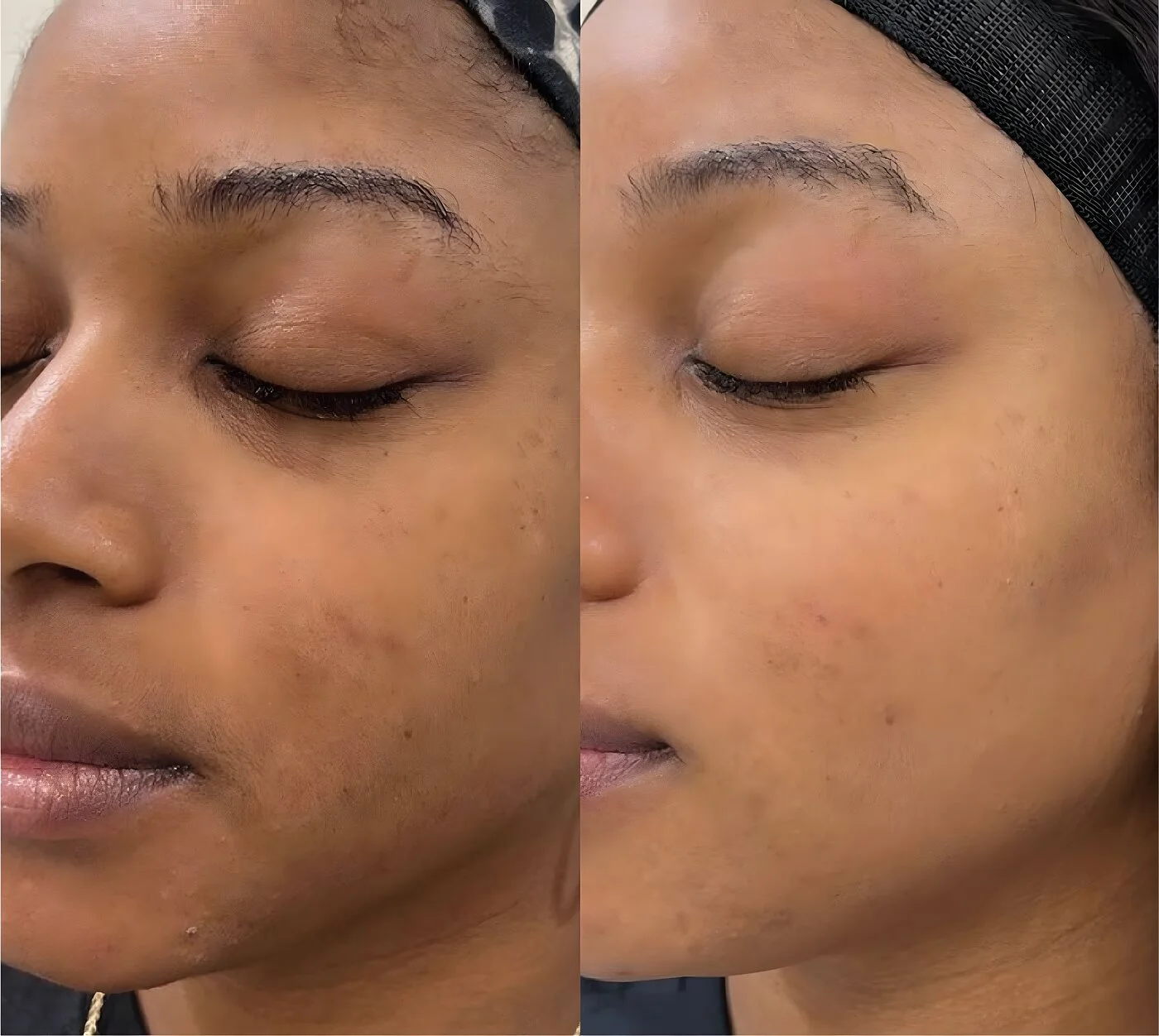
Melasma & uneven tone — VI chemical peel. Patchy cheek pigmentation softened toward a more uniform tone over a peel series. Courtesy of the VI Peel provider network.
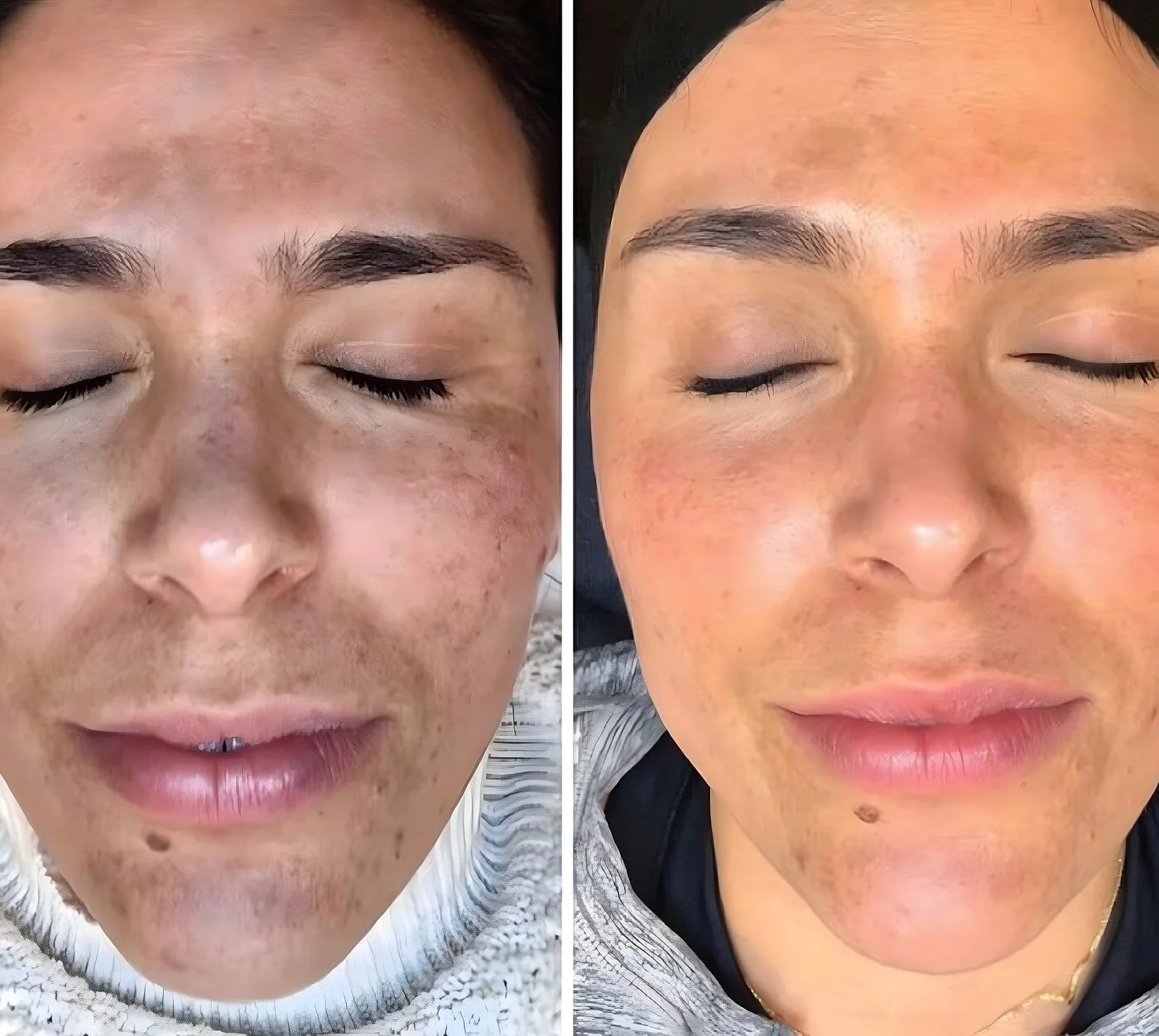
Sun damage & freckling — VI chemical peel. Diffuse sun damage and freckling refined to a clearer, brighter finish. Courtesy of the VI Peel provider network.
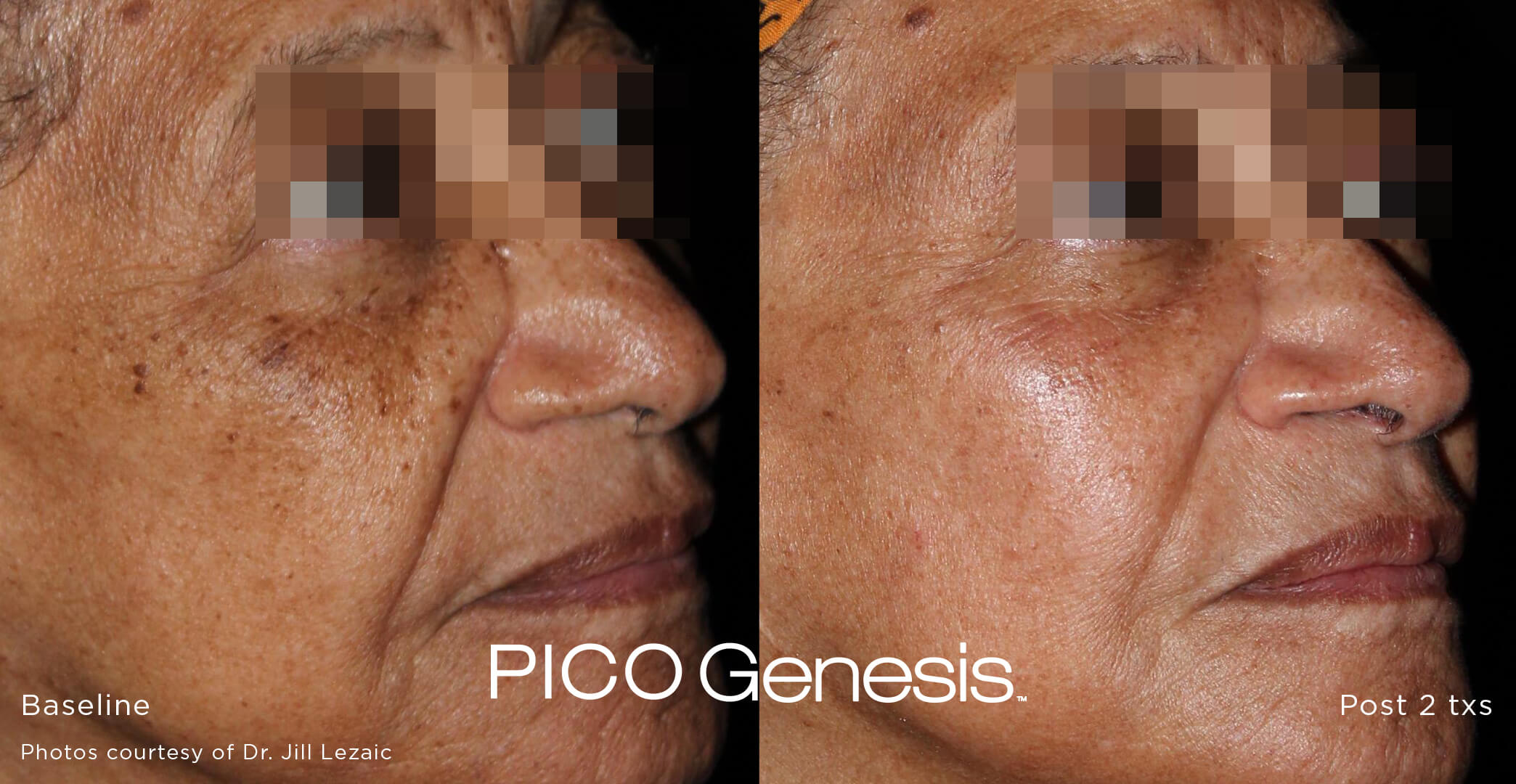
Diffuse pigment cleanup — Pico Genesis. Mottled full-face pigment softened toward a more uniform complexion after two photoacoustic sessions. Courtesy of Dr. Jill Lezaic.
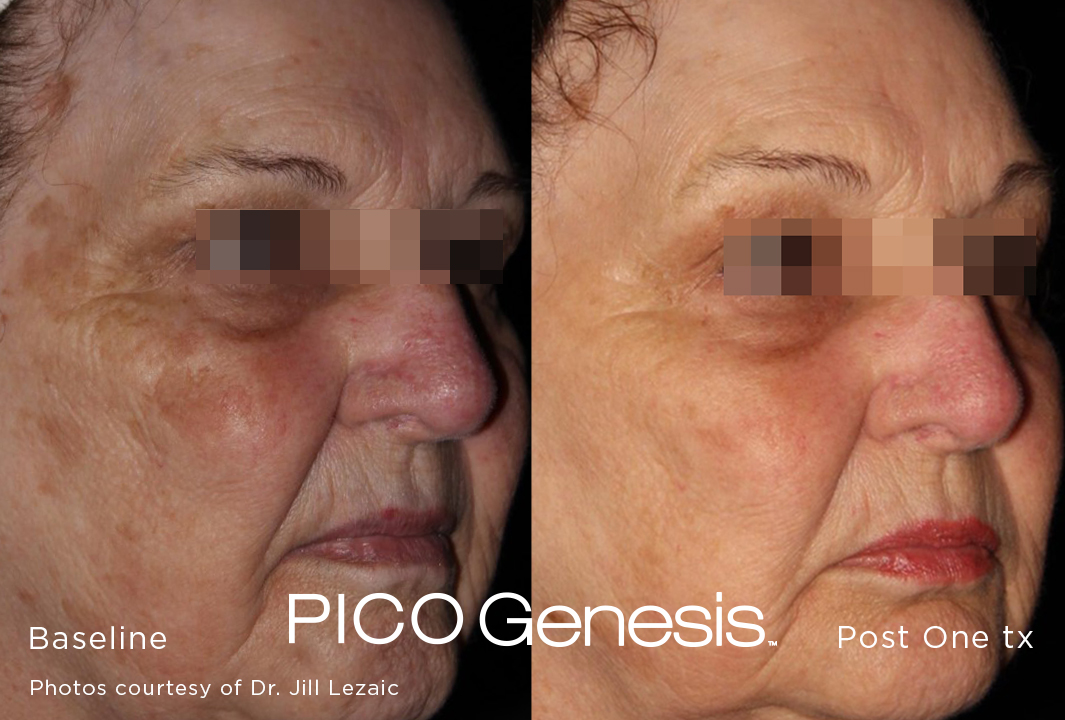
Age-spot reduction — Pico Genesis. Cheek and temple age spots visibly reduced after one photoacoustic session. Courtesy of Dr. Jill Lezaic.
Photos courtesy of the VI Peel provider network and Dr. Jill Lezaic — not Miami Skin Spa patients. Individual results vary, and not all treatments are appropriate for melasma; a skin analysis determines what is safe for your skin type.
Frequently asked questions
Melasma is chronic, so it's controlled and faded rather than permanently cured. Around half of patients relapse within six months without maintenance.8 With consistent topicals and daily tinted sun protection, most people keep it well managed long-term.
Plan on months, not days. Epidermal (surface) melasma fades fastest; dermal and mixed types fade more slowly and partially.1 A steady, layered plan beats any single aggressive treatment.
A broad-spectrum SPF 30–50 that is tinted with iron oxides, because melasma is also driven by visible light that ordinary sunscreen lets through. Randomized trials show tinted sunscreen prevents relapse better than untinted.20,22 Reapply through the day; the tint is doing real work, not just evening your tone.
Used correctly it remains the most effective topical lightener and the backbone of the FDA-approved triple cream. It's used in cycles rather than indefinitely to avoid a rare paradoxical darkening (ochronosis), and there are excellent non-hydroquinone options — azelaic acid, thiamidol, tranexamic acid — for maintenance.14,15
Picosecond lasers shatter pigment with photoacoustic energy and far less heat than older lasers, which makes them better suited to deeper skin tones — but melasma still demands gentle, spaced sessions plus topicals and strict photoprotection, because over-treating can rebound.17,19 We assess your skin type first and often start with a test spot.
Sun spots (from cumulative UV) and post-acne marks are usually localized and respond well to laser or peels. Melasma is symmetrical, hormone- and light-driven, deeper, and far more likely to recur or worsen if treated aggressively.1 They look similar but are managed very differently — which is why we diagnose before we treat.
Sources & further reading
Peer-reviewed reviews, randomized trials, meta-analyses and clinical references on melasma and pigmentation. Where a stable link was available it is included; all entries give a full citation. Links open in a new tab.
- Melasma. StatPearls (NCBI Bookshelf). Updated 2026. https://www.ncbi.nlm.nih.gov/books/NBK459271/
- Pathogenesis of Melasma Explained. Int J Dermatol / PMC. 2025. https://pmc.ncbi.nlm.nih.gov/articles/PMC12207721/
- Zheng J, et al. Understanding Melasma: From Pathogenesis to Innovative Treatments. Dermatologic Therapy. 2024. https://onlinelibrary.wiley.com/doi/full/10.1155/2024/2206130
- New Mechanistic Insights of Melasma. Clin Cosmet Investig Dermatol. 2023. https://www.dovepress.com/new-mechanistic-insights-of-melasma-peer-reviewed-fulltext-article-CCID
- Hormonal Crosstalk in Melasma: Estrogen and Progesterone in Melanogenesis. 2025. https://www.ncbi.nlm.nih.gov/pmc/articles/PMC12652859/
- Hill RC, et al. The Burden of Melasma: Race, Ethnicity, and Comorbidities (All of Us database). J Drugs Dermatol. 2024;23(8):691-693. https://pubmed.ncbi.nlm.nih.gov/39093647/
- Melasma: Background, Pathophysiology, Etiology (epidemiology). Medscape eMedicine. https://emedicine.medscape.com/article/1068640-overview
- Global Epidemiology: Melasma (relapse ~47% within 6 months without maintenance). 2026. https://www.ijpsjournal.com/article/Global+Epidemiology+Melasma
- A Scoping Review on Melasma Treatments and Their Histopathologic Correlates (PIH risk in skin of color). 2025. https://pmc.ncbi.nlm.nih.gov/articles/PMC12015840/
- Efficacy and Safety of Tranexamic Acid in Melasma: A Meta-analysis and Systematic Review. Acta Derm Venereol. https://www.medicaljournals.se/acta/content/html/10.2340/00015555-2668
- Liang J, et al. Comparative efficacy and safety of tranexamic acid for melasma by administration: a network meta-analysis. J Cosmet Dermatol. 2024. https://onlinelibrary.wiley.com/doi/10.1111/jocd.16104
- Tranexamic acid as a therapeutic option for melasma: meta-analysis of RCTs (22 studies, 1280 patients). J Dermatolog Treat. 2024. https://www.tandfonline.com/doi/full/10.1080/09546634.2024.2361106
- Efficacy and Safety of Different Treatments for Melasma: Network Meta-Analysis of Updated Data. 2025. https://pmc.ncbi.nlm.nih.gov/articles/PMC12562867/
- Chang Y-F, et al. Efficacy and safety of topical agents in melasma: a systematic review and meta-analysis. J Cosmet Dermatol. 2023. https://onlinelibrary.wiley.com/doi/10.1111/jocd.15566
- An Update on New and Existing Treatments for the Management of Melasma. Am J Clin Dermatol. 2024. https://link.springer.com/article/10.1007/s40257-024-00863-2
- Lima PB, et al. Topical isobutylamido thiazolyl resorcinol (Thiamidol) vs. 4% hydroquinone for facial melasma: evaluator-blinded RCT. J Eur Acad Dermatol Venereol. 2021.
- Efficacy and Safety of Laser-Based Therapies for Melasma: a Systematic Review and Meta-Analysis. Cureus. 2026. https://www.cureus.com/articles/473939-efficacy-and-safety-of-laser-based-therapies-for-melasma-a-systematic-review-and-meta-analysis
- Lee YS, et al. The Low-Fluence Q-Switched Nd:YAG Laser Treatment for Melasma: A Systematic Review. Medicina. 2022. https://www.ncbi.nlm.nih.gov/pmc/articles/PMC9323185/
- Picosecond Nd:YAG (1064 nm) vs picosecond alexandrite (755 nm) vs 2% hydroquinone for melasma: RCT (references 59-RCT NMA ranking QS Nd:YAG first). Front Med. 2023. https://pmc.ncbi.nlm.nih.gov/articles/PMC10086227/
- Boukari F, Passeron T, et al. Prevention of melasma relapses with sunscreen combining UV and short-wavelength visible-light protection: prospective randomized trial. J Am Acad Dermatol. 2015. https://www.jaad.org/article/S0190-9622(14)01870-2/fulltext
- He X, et al. Visible Light Protection: An Updated Review of Tinted Sunscreens. Photodermatol Photoimmunol Photomed. 2025. https://onlinelibrary.wiley.com/doi/10.1111/phpp.70033
- Comparison of a visible-light-protective tinted sunscreen to untinted sunscreen in melasma patients during summer: randomized investigator-blinded study. J Cosmet Dermatol. 2025. https://www.ncbi.nlm.nih.gov/pmc/articles/PMC12475913/
- Hyperpigmentation in Darker Skin Types (peels, lasers and PIH; skin-of-color management). Practical Dermatology. 2024. https://assets.bmctoday.net/practicaldermatology/pdfs/PD0324_CoverFeature_Frey_Hyperpigmentation.pdf
- Melasma: A Step-by-Step Approach Towards a Multimodal Combination Therapy. 2024. https://pmc.ncbi.nlm.nih.gov/articles/PMC11128260/