Sun damage in Brickell,
Miami.
Most of what we call "aging" is really the sun. This is your decision hub for sun damage treatment in Miami and Brickell: how UV quietly rebuilds your skin into spots, redness, rough texture and fine lines, which treatments actually repair sun-damaged skin, and the medical truth — some rough spots are precancers, not cosmetics. Whether you want to reverse sun damage with a photofacial, laser or peel, book a consultation and we'll read your skin first.
Medically reviewed by Mariana Tolosa, PA-C📍 1501 South Miami Avenue #201, Brickell🔬 22 cited sources · peer-reviewed🗓️ Reviewed 2026
The sun writes on your skin
Dermatologists separate two kinds of aging: intrinsic aging from the passage of time, and photoaging from ultraviolet light. The striking part is how lopsided they are — sunlight is the single biggest cause of how aged skin looks, with UVA reaching deep into the dermis to break down collagen and pile up abnormal elastin, while UVB damages the surface and its DNA.1,2 The result shows up four ways: blotchy pigment, redness and broken capillaries, rough texture and fine lines, and — the medical one — scaly precancers.2
At Miami Skin Spa in Brickell we treat sun-damaged skin by matching the tool to the feature: Lumecca IPL for sun spots and redness, laser resurfacing and microneedling for texture, a prescription retinoid to rebuild collagen, and a deliberately pigment-safe approach for deeper skin tones.9,11 Two truths anchor all of it. First, prevention beats repair: in a randomized trial, daily sunscreen cut measurable skin aging by 24%.5 Second, a rough or changing spot may be an actinic keratosis — a precancer that belongs with a dermatologist, not under a cosmetic laser.14,15
Two rays, different damage
Sunlight reaches the skin as UVA and UVB, and they injure it in different places. Understanding which is which explains why sun damage looks the way it does — and why one treatment can't fix all of it.1,4
UVB is the shorter, higher-energy ray. Most of it is absorbed in the epidermis, where it damages DNA, drives the tan and the sunburn, and over time creates the surface pigment and scaly precancers of sun damage.1,2 UVA is longer and penetrates far deeper, into the dermis, where it shatters collagen and triggers the body to make abnormal, clumped elastin — a process called solar elastosis. Repair enzymes (matrix metalloproteinases) switch on but rebuild the skin badly, so collagen is lost and the skin becomes lined, lax and leathery.2,3
This is why sun damage is cumulative and quiet: every unprotected exposure nudges the skin a little further, and the damage from your teens and twenties surfaces decades later. Lighter skin has a natural SPF of only about 3.3 and shows more wrinkling and cancer risk; richer, melanin-dense skin has more built-in protection (around SPF 13) but tends to show sun damage as pigment and is more prone to dark marks after inflammation.4 Visible light from the sun — strong all year in Miami — adds to pigment too.18
One cause, four problems
Sun damage rarely shows up as just one thing. Most people have a mix, and each face has its own best treatment — which is why we read the whole picture before choosing.2,9
Pigment
Sun spots, age spots, freckles and blotchy, uneven tone — the most visible and most treatable sign of sun damage.
See: Dark spots →Redness & vessels
Diffuse redness, flushing and broken capillaries (telangiectasia) from chronic UV — well suited to IPL.
See: Lasers →Texture & lines
Fine lines, rough texture, enlarged pores and a dull, leathery surface from collagen loss.
See: Lasers →Precancers
Rough, scaly actinic keratoses are precancers — a medical matter for a dermatologist, not a cosmetic laser.
See a doctorWhy this page sends you elsewhere
Sun damage is the umbrella. For discrete brown spots we go deeper on our dark spots page; mask-like melasma lives on the hyperpigmentation hub; and crepey, sun-laxed skin is covered under skin tightening. Use this page to understand the whole picture, then dive into the part that fits you.
What does yours look like?
Pick what bothers you most and your skin tone. We'll point to the approach that usually fits — and flag plainly when a spot needs a doctor first. This is guidance; your consultation confirms the plan.2,9
One spot rules them all. A rough, scaly patch that won't heal, or any spot that is new, growing or changing, should be checked by a dermatologist before cosmetic treatment — it can be an actinic keratosis (a precancer) or skin cancer. We assess first and refer out anything suspicious.14,15
1 · What bothers you most?
2 · Your skin tone
On olive skin, sun-induced brown clears with a picosecond laser or carefully dialed IPL plus brightening topicals — we choose gentler settings and a test spot to avoid a temporary dark mark.
Skin tone changes the safe choice. In fair skin, broadband IPL is a workhorse for sun spots and redness. In medium and especially deep, melanin-rich skin, IPL and aggressive fractional resurfacing are used cautiously or avoided — they can trigger dark marks — so we lean on a 1064 nm laser, microneedling, RF and topicals, always with a test spot.11,12,20,21 Brickell's diverse skin is exactly why one device can't fit everyone.
Matched to the feature
There's no single "sun damage treatment" — repairing sun-damaged skin means combining a few tools, each aimed at a different face of photoaging, on top of the foundation that protects the result.9,11,22
Lumecca IPL (photofacial)
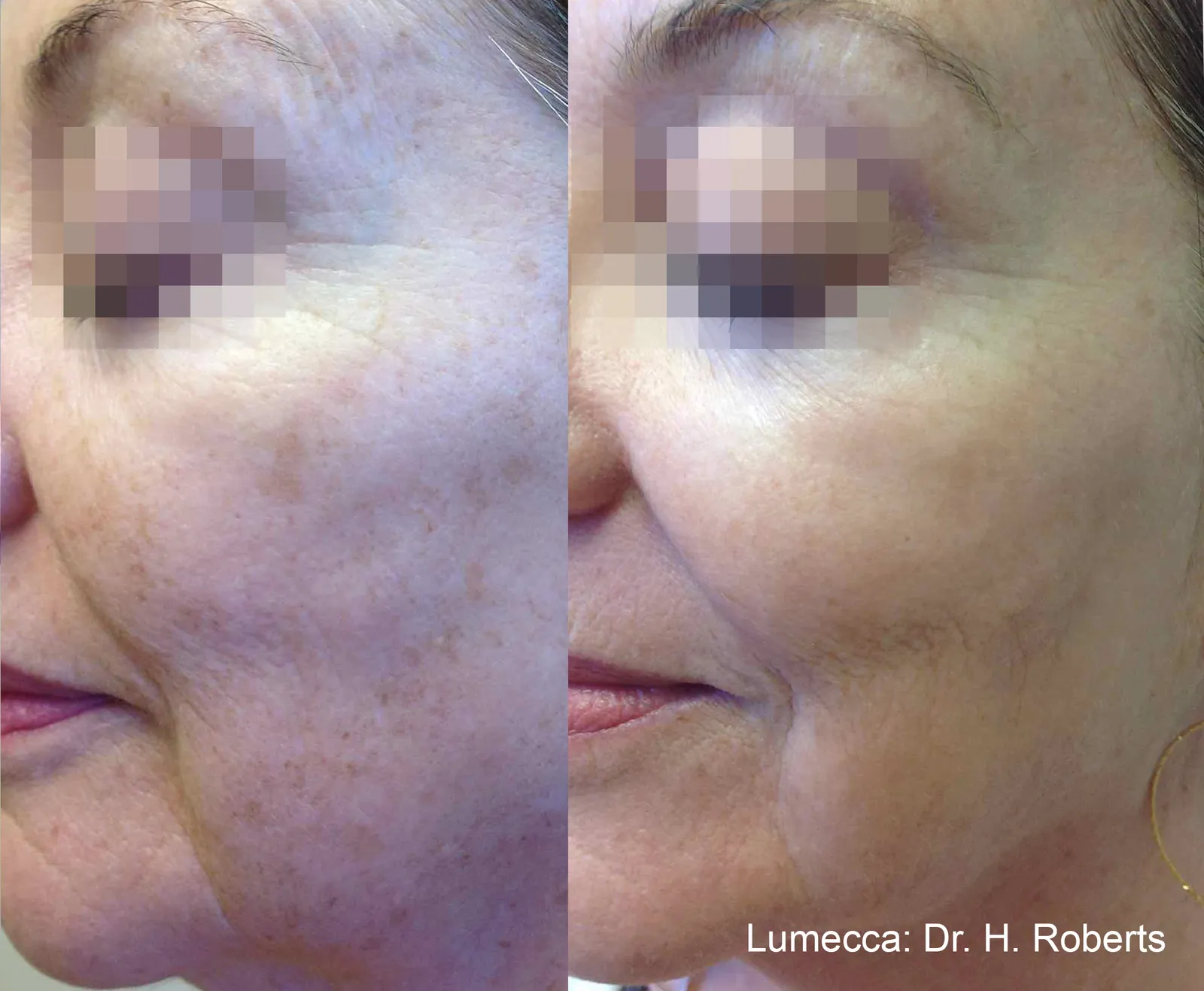
The signature sun-damage treatment for fair-to-medium skin: broadband light clears brown spots and the redness and broken capillaries of photoaging. In a 4-year study, IPL improved texture in 83%, redness in 82% and pigment in 79% of patients.9 Less effective for wrinkles, so we combine.10
Picosecond laser & Pico Genesis
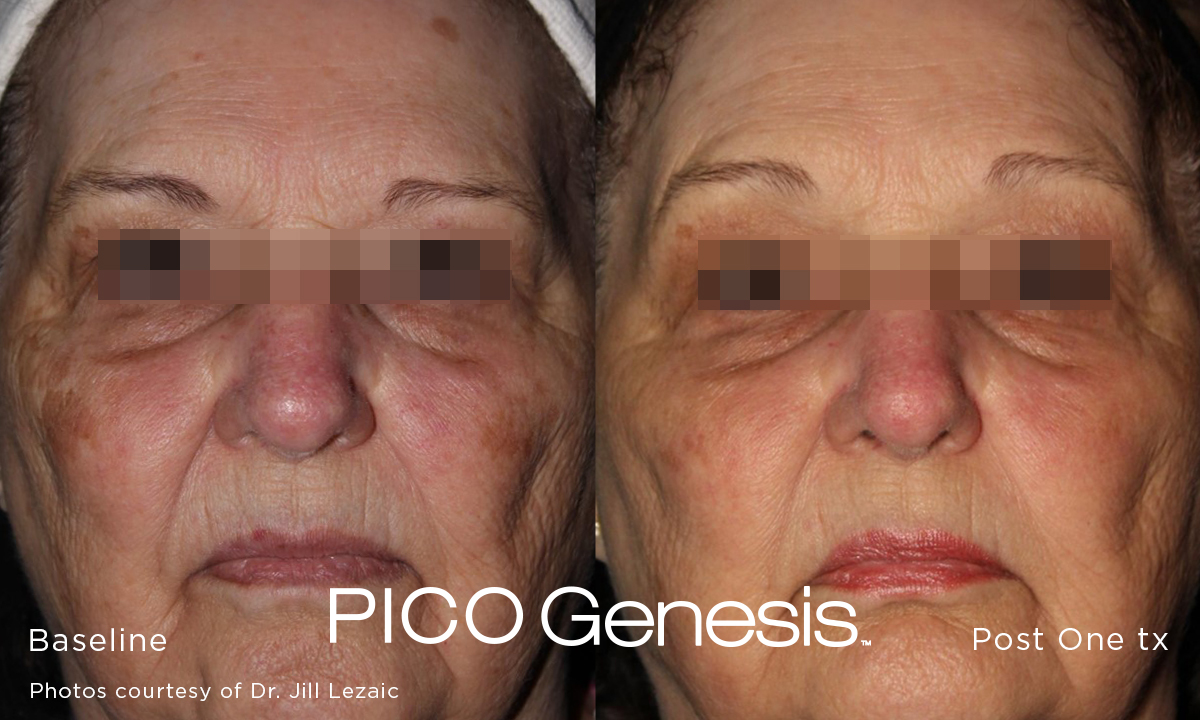
Our Enlighten picosecond laser shatters sun-induced pigment, and a 1064 nm wavelength treats spots safely in deeper tones; Pico Genesis evens overall tone. We go spot-by-spot on the dark spots page.13,20
Laser resurfacing & microneedling
For fine lines, rough texture and pores, fractional resurfacing and SkinPen microneedling rebuild collagen. Fractional laser is powerful but can cause dark marks in deeper skin, so we calibrate or favor microneedling there.11
Morpheus8 (RF microneedling)
Years of sun loosen skin via collagen loss and elastosis. Morpheus8 radiofrequency remodels collagen to firm crepey, sun-laxed skin, and because it heats by depth rather than pigment it's comparatively safe across tones — more on the skin tightening hub.4
| Treatment | Targets | How it works | Skin-tone fit | Downtime | Sessions |
|---|---|---|---|---|---|
| Lumecca IPLHere | Brown spots, redness, broken capillaries | Broadband light absorbed by pigment & vessels | Best Fitz I–III; avoided on tanned/deep skin | Spots flake, redness settles, 3–7 days | 1–3+ |
| Pico / Q-switched laser (Enlighten)Here | Discrete sun & age spots | Ultra-short pulses shatter pigment | All tones at 1064 nm; tailored energy | Tiny crust, a few days | 1–3 |
| Pico GenesisHere | Diffuse dullness, scattered brown, tone | Picosecond laser facial | Most tones; conservative in deep skin | Minimal redness | 2–4 |
| Laser resurfacing / SkinPenHere | Fine lines, texture, pores | Fractional injury triggers new collagen | All tones; gentler/microneedling in deep skin | Redness/flaking, 2–7 days | Series |
| Morpheus8 (RF microneedling)Here | Texture + crepey laxity / elastosis | RF heat remodels collagen | All tones; heats by depth, not pigment | Redness 1–3 days | ≈3 |
| Medical-grade topicals (Rx)Here | Lines, pigment, prevention — the foundation | Retinoids build collagen; vitamin C, SPF | All tones; provider-guided | None | Daily, ongoing |
Not all sun damage is cosmetic
This is the section a responsible sun-damage page can't skip. The same UV that ages skin also causes skin cancer, and one common sign of sun damage — a rough, scaly spot called an actinic keratosis — is a precancer. More than 70% of cutaneous squamous-cell carcinomas arise from these lesions.2,15
Actinic keratoses are rough, scaly, sometimes tender patches on sun-exposed skin — the scalp, face, ears, forearms and hands. Any single one has only a small yearly chance of turning into cancer, and some fade on their own, but people who have them usually have many across a sun-damaged "field," which raises the cumulative risk.16 They are treated medically — cryotherapy, prescription creams such as 5-fluorouracil or imiquimod, or photodynamic therapy — by a dermatologist, not with a cosmetic laser.16,17
That's why we always assess your skin before any treatment and refer out anything suspicious. A cosmetic photofacial or laser can lighten a spot's appearance and mask a cancer, delaying diagnosis. Cosmetic sun-damage treatment is not a substitute for a skin-cancer check. For high-risk patients, dermatologists may also recommend oral nicotinamide (vitamin B3), which in a randomized trial lowered new skin cancers by 23%.14
The ABCDEs — get a spot checked if you see:
A simple rule. A rough, scaly spot that won't heal, a sore that scabs and returns, or any new or changing mole — see a dermatologist first. Cosmetic treatment can wait; a diagnosis can't.15
What a photofacial really delivers
A long-term study followed sun-damaged patients (skin types I–IV) treated with IPL and graded them four years later. Here's the real picture: IPL is strong for pigment, redness and texture — and weaker for wrinkles, which need other tools.9
Prevention beats repair
The most powerful intervention isn't a laser — it's sunscreen. In a 4.5-year randomized trial, daily sunscreen users had 24% less skin aging than discretionary users and showed no detectable increase in photoaging.5 Every plan we build starts here.
Clearer in weeks, firmer in months
Pigment and redness clear over a few weeks; texture and firmness build more slowly as new collagen forms. Then protection keeps the gains.6,9
The treatment that never ends
Daily broad-spectrum SPF is the foundation of any sun-damage plan — and for pigment-prone or deeper skin, a tinted mineral sunscreen with iron oxides matters, because ordinary mineral filters don't block the visible light that also drives pigment.18,19 Pair it with a nightly retinoid and you keep rebuilding collagen between treatments.6
Sun-damaged skin? Start with a careful read.
Our Brickell team maps the faces of sun damage you actually have, checks anything that needs a doctor's eye, and builds a plan matched to your skin tone — photofacial, laser, resurfacing, topicals, or a referral when a spot should be seen first.
Miami Skin Spa · Brickell · 1501 South Miami Avenue #201, Miami, FL 33129 · 305-557-1615
A plan, not a single fix
Sun damage treatment in Brickell works best as a layered plan — clear pigment and redness, rebuild texture and collagen, and protect against the next wave of UV.9,11
Sessions & maintenance
A photofacial series is often 1–3+ sessions; texture and collagen build over a series of resurfacing or microneedling across 2–3 months. Periodic maintenance plus daily SPF keeps pace with ongoing sun exposure.9
The Miami reality
At a subtropical latitude with intense, year-round UV, sun damage is nearly universal in Miami and Brickell — and skin here spans every Fitzpatrick type. Because we run a full menu — IPL, picosecond laser, Pico Genesis, resurfacing, microneedling, RF and medical-grade topicals — we can pick the pigment-safe tool for your skin and test before treating deeper tones.4,12
The full menu, matched to you
Patients across Miami and Brickell come to us to treat sun-damaged skin because we don't sell a single device. Our team — including aesthetician Amy Betancourt, with 13+ years in facials, peels and Pico — reads the faces of sun damage you have, recommends what fits, combines treatments when it helps, and refers out when a spot should be seen by a physician first.
Explore the treatments & related concerns
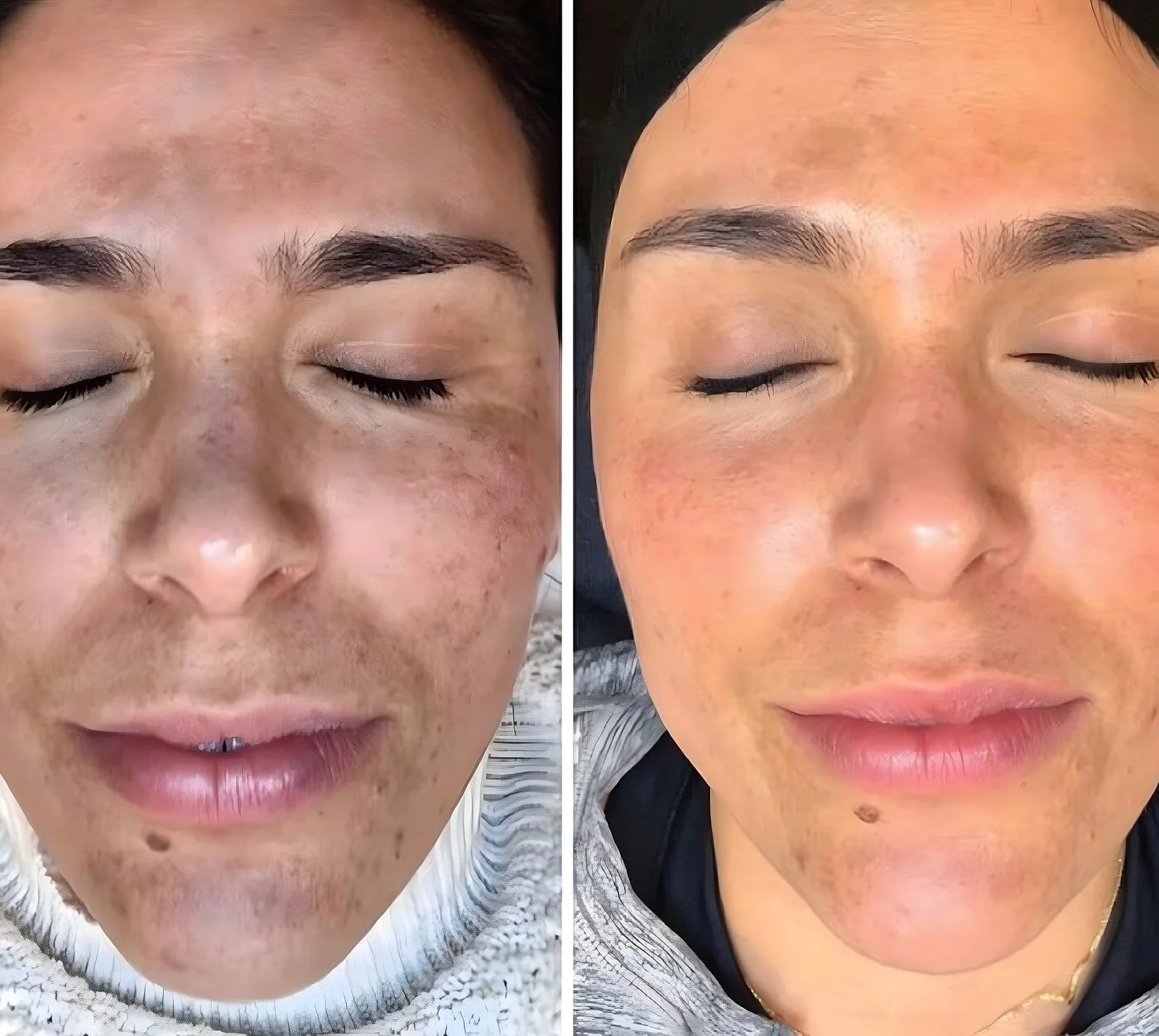
Before & after
Frequently asked questions
There's no single best — it depends on which faces of sun damage you have. Brown spots and redness respond to IPL/photofacial; texture and fine lines to laser resurfacing, microneedling and a retinoid; sun-laxed skin to radiofrequency. Most plans combine a few. Our decision tool above and a consultation match the right sun damage treatment in Miami and Brickell to your skin and tone.2,9
Much of it, yes — within limits. Treatments clear sun spots and redness, resurfacing and microneedling rebuild texture, and a prescription retinoid restores collagen the sun depleted.6 What no treatment does is stop new damage, so results fade without daily sun protection, and deep wrinkles or true excess skin need other approaches.5
For pigment and redness, very much. In a 4-year study, IPL improved skin texture in 83% of patients, telangiectasia (redness and vessels) in 82% and mottled pigmentation in 79%, with a median of three treatments.9 IPL does little for wrinkles on its own, so we pair it with resurfacing or a retinoid, and it's used cautiously on tanned or deep skin.10,12
Both. The same UV that ages skin causes skin cancer, and a common sign of sun damage — a rough, scaly actinic keratosis — is a precancer; more than 70% of squamous-cell skin cancers arise from them.2,15 These are treated medically by a dermatologist, and cosmetic treatment is never a substitute for a skin-cancer check.16
It's a rough, scaly, sometimes tender patch on sun-exposed skin (scalp, face, ears, hands) caused by cumulative UV — considered a precancer. Any single lesion has a small yearly chance of becoming a squamous-cell carcinoma, but having many raises the cumulative risk.16 Treatment is medical (cryotherapy, prescription creams, photodynamic therapy), so we refer these out rather than treating them cosmetically.17
Yes, with the right choices. We favor a 1064 nm picosecond laser, microneedling, radiofrequency and topicals and avoid broadband IPL and aggressive fractional resurfacing, which can cause post-inflammatory dark marks in melanin-rich skin.11,12,20 Because Miami and Brickell skin is so diverse, we always assess skin type and test before treating.
Daily broad-spectrum SPF is the highest-value step — a randomized trial found daily users had 24% less skin aging than occasional users.5 For pigment-prone or deeper skin, choose a tinted mineral sunscreen with iron oxides to also block visible light, add a nightly retinoid and antioxidants, and protect with shade, hats and timing.6,18
Sources & further reading
Peer-reviewed reviews and clinical trials, systematic reviews and meta-analyses, landmark randomized trials, and device and photoprotection literature on photoaging, sun-damage treatment, actinic keratoses and skin-cancer prevention. Where a stable link was available it is included. Links open in a new tab.
- Aging and the impact of solar UV on type I/VI collagen — review: ~80% of UVB is absorbed by the epidermis and UVA penetrates the dermis, destroying fibroblasts and collagen and driving matrix metalloproteinase (MMP) collagen breakdown. Cosmetics 2023. https://www.mdpi.com/2079-9284/10/2/48
- Photoaging — what you need to know (Skin Cancer Foundation): sunlight is the number-one cause of skin aging; UVA degrades dermal collagen and triggers abnormal elastin and MMPs, producing wrinkles and leathery skin; melasma, freckles, actinic keratoses and texture changes are all signs of photoaging. https://www.skincancer.org/blog/photoaging-what-you-need-to-know/
- Photoaging — UV-induced inflammation and immunosuppression: UV drives collagen fragmentation, MMP-mediated extracellular-matrix degradation, and accumulation of abnormal elastin (solar elastosis), accelerating skin aging. 2022. https://pmc.ncbi.nlm.nih.gov/articles/PMC9307547/
- Comprehensive review of UV radiation in photoaging across skin types: light skin (I–III) has a natural SPF of only ~3.3 vs ~13.4 for darker skin (IV–VI); UVA promotes collagen degradation and laxity, UVB causes DNA mutations and cancer, and darker skin shows more post-inflammatory pigment and later, worse-outcome cancer diagnoses. 2025. https://pmc.ncbi.nlm.nih.gov/articles/PMC12018068/
- Sunscreen and prevention of skin aging — randomized controlled trial (Nambour, Australia; 903 adults < 55): daily broad-spectrum sunscreen produced 24% less skin aging than discretionary use over 4.5 years, with no detectable increase in photoaging; β-carotene had no effect. Ann Intern Med 2013. https://pubmed.ncbi.nlm.nih.gov/23732711/
- Restoration of collagen formation in photodamaged human skin by tretinoin (retinoic acid) — landmark study showing topical tretinoin restores collagen synthesis lost to sun damage. NEJM 1993. https://www.nejm.org/doi/full/10.1056/NEJM199308193290803
- Tretinoin for photodamaged facial skin — systematic review and meta-analysis of RCTs (8 trials, 1,361 patients): topical tretinoin significantly improved both fine and coarse wrinkles vs vehicle. 2025. https://pmc.ncbi.nlm.nih.gov/articles/PMC12615114/
- Comparative efficacy of topical interventions for facial photoaging — network meta-analysis (23 RCTs, 3,905 participants): isotretinoin, retinol and tretinoin significantly improved fine wrinkles; tretinoin and retinol were best for hyperpigmentation; glycolic acid reduced roughness. Sci Rep 2025. https://www.nature.com/articles/s41598-025-12597-0
- Rejuvenation of photoaged skin — 4-year results with intense pulsed light (face, neck, chest; skin types I–IV): texture improved in 83% of patients, telangiectasias in 82% and mottled pigmentation in 79%, with a median of 3 treatments and minimal downtime. Dermatol Surg 2002. https://pubmed.ncbi.nlm.nih.gov/12472489/
- Current trends in intense pulsed light — review: IPL is versatile and effective for vascular and pigmented lesions and the dyschromia of photoaging, but is less effective for wrinkles. JCAD. https://jcadonline.com/current-trends-in-intense-pulsed-light/
- Ablative fractional CO2 laser combined with IPL for photoaging (split-face): IPL is effective for lentigines, telangiectasia and erythema but less so for wrinkles, while fractional laser improves wrinkles and texture but can cause post-inflammatory hyperpigmentation, especially in Asian/darker skin; combination was safe and effective. 2018. https://www.ncbi.nlm.nih.gov/pmc/articles/PMC5779741/
- Long-term regular IPL for facial rejuvenation — real-world study (236 patients, ≥6 sessions): significant improvement in erythema, pigmentation and wrinkle indices; Fitzpatrick type IV skin showed lower response rates. 2026. https://www.ncbi.nlm.nih.gov/pmc/articles/PMC12833585/
- Treatment of solar lentigines — systematic review of 41 trials: reported clearance for sun spots by modality — IPL 74.6–90%, picosecond laser 67.9–93.0%, Q-switched laser 36.4–76.6%, fractional CO2 8–23%, TCA peel 12–46%. 2024. https://pmc.ncbi.nlm.nih.gov/articles/PMC11948172/
- Phase 3 randomized trial of oral nicotinamide (vitamin B3) 500 mg twice daily for skin-cancer chemoprevention (ONTRAC): 23% lower rate of non-melanoma skin cancers and 11–20% fewer actinic keratoses vs placebo in high-risk immunocompetent patients. NEJM 2015. https://www.nejm.org/doi/full/10.1056/nejmoa1506197
- From actinic keratosis to cutaneous squamous-cell carcinoma — review: actinic keratosis (AK) is a UV-induced precancer, and more than 70% of cutaneous SCCs arise from AK. 2025. https://www.frontiersin.org/journals/immunology/articles/10.3389/fimmu.2025.1518633/full
- Treatment of actinic keratosis and field cancerization — review: AK has a global prevalence near 14%; individual-lesion progression risk is roughly 0–0.53% per year with ~23% spontaneous regression, but multiple lesions raise cumulative risk; lesion- and field-directed treatments include cryotherapy, 5-fluorouracil, imiquimod and photodynamic therapy. 2025. https://www.ncbi.nlm.nih.gov/pmc/articles/PMC12471434/
- Management of actinic keratoses and field cancerization — review: field cancerization involves clinical and subclinical AKs across sun-exposed skin; field-directed therapy can reduce recurrence and potentially SCC risk; oral nicotinamide 500 mg twice daily reduced AK and new skin cancers in high-risk patients. 2020. https://link.springer.com/article/10.1007/s13555-020-00425-4
- Photoprotection beyond ultraviolet radiation — review of tinted sunscreens: visible light contributes to pigmentation; mineral filters alone do not block it, while iron-oxide tinted sunscreens do, benefiting melasma and PIH. JAAD 2021. https://pubmed.ncbi.nlm.nih.gov/32335182/
- Visible-light-protective tinted vs untinted sunscreen — prospective randomized investigator-blinded study: iron-oxide tinted sunscreen reduces visible-light transmittance and helps prevent pigment relapse. 2025. https://www.ncbi.nlm.nih.gov/pmc/articles/PMC12475913/
- Picosecond 532 nm vs low-fluence 1064 nm Nd:YAG in Fitzpatrick III–VI — comparable facial pigment clearance, with the 1064 nm wavelength penetrating deeper and showing a favorable safety profile in skin of color. Cosmetics 2024. https://doaj.org/article/d139a099a97a4653a526e2a2b204ab67
- Long-pulsed alexandrite laser for solar lentigines — Q-switched lasers carry a higher risk of post-inflammatory hyperpigmentation in darker skin types. Turkderm 2023. https://doi.org/10.4274/turkderm.galenos.2023.21855
- Updated review of topical tretinoin in dermatology — from acne and photoaging to skin cancer: tretinoin improves photoaging (fine wrinkles, mottled pigmentation, sallowness) by stimulating collagen and suppressing MMPs, and has been studied in actinic-damage prevention. J Clin Med 2025. https://www.mdpi.com/2077-0383/14/22/7958