Laser Hair Removal in Brickell, Miami
Permanent hair reduction with two complementary laser systems — Diolaze by InMode and excel HR by Cutera — matched to your skin tone, hair type, and treatment area. Used across a wide range of skin tones, including darker skin, with minimal discomfort, no downtime, and sessions lasting minutes to an hour.
Medically reviewed by Morgan Winters, FNP-C1501 South Miami Avenue #201, BrickellDiolaze® by InMode · excel HR® by CuteraPart of: Body Contouring
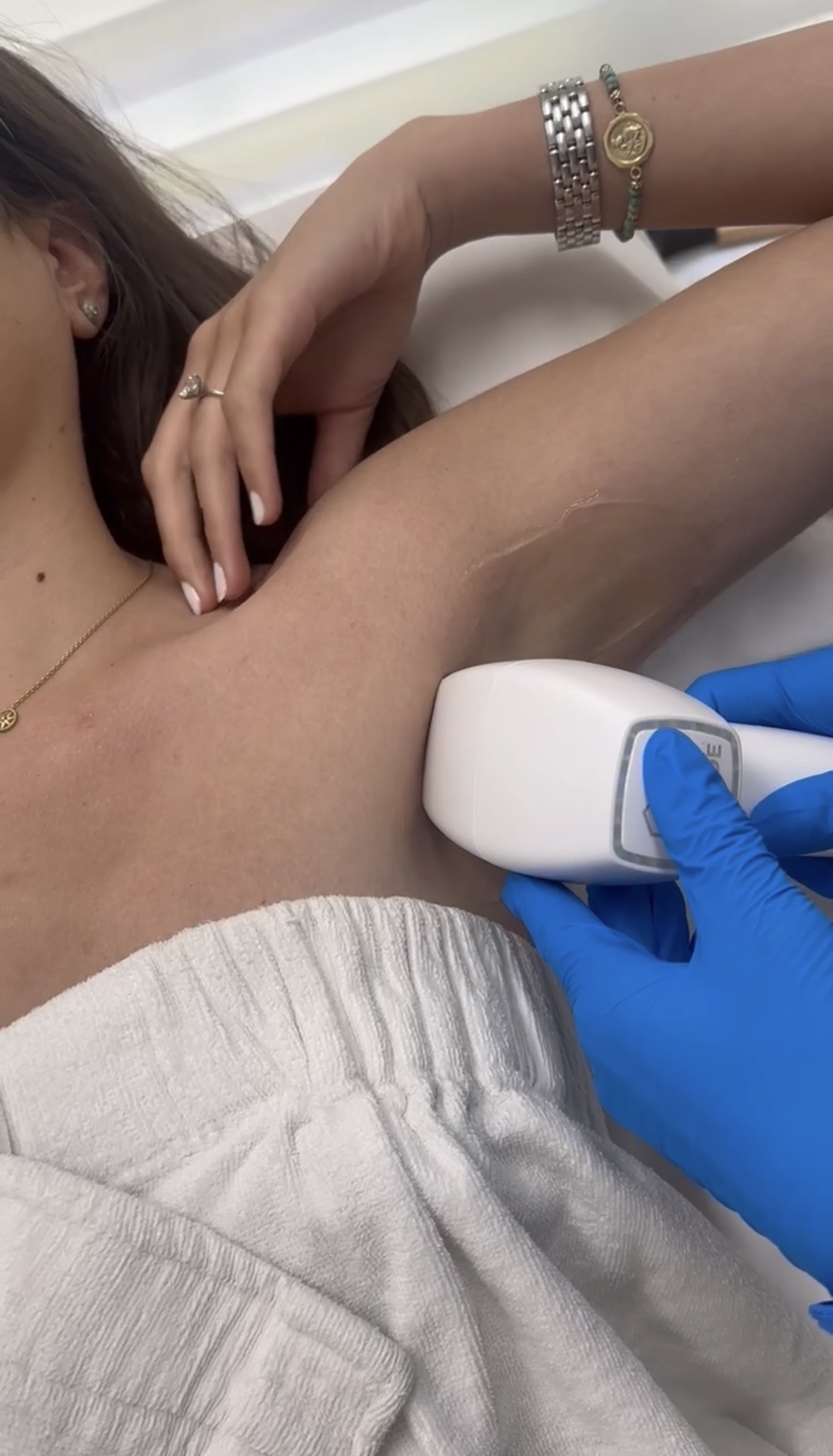
Laser hair removal at our Brickell clinic
Real treatment photography from Miami Skin Spa. Individual results vary — see more patient outcomes in our results gallery.
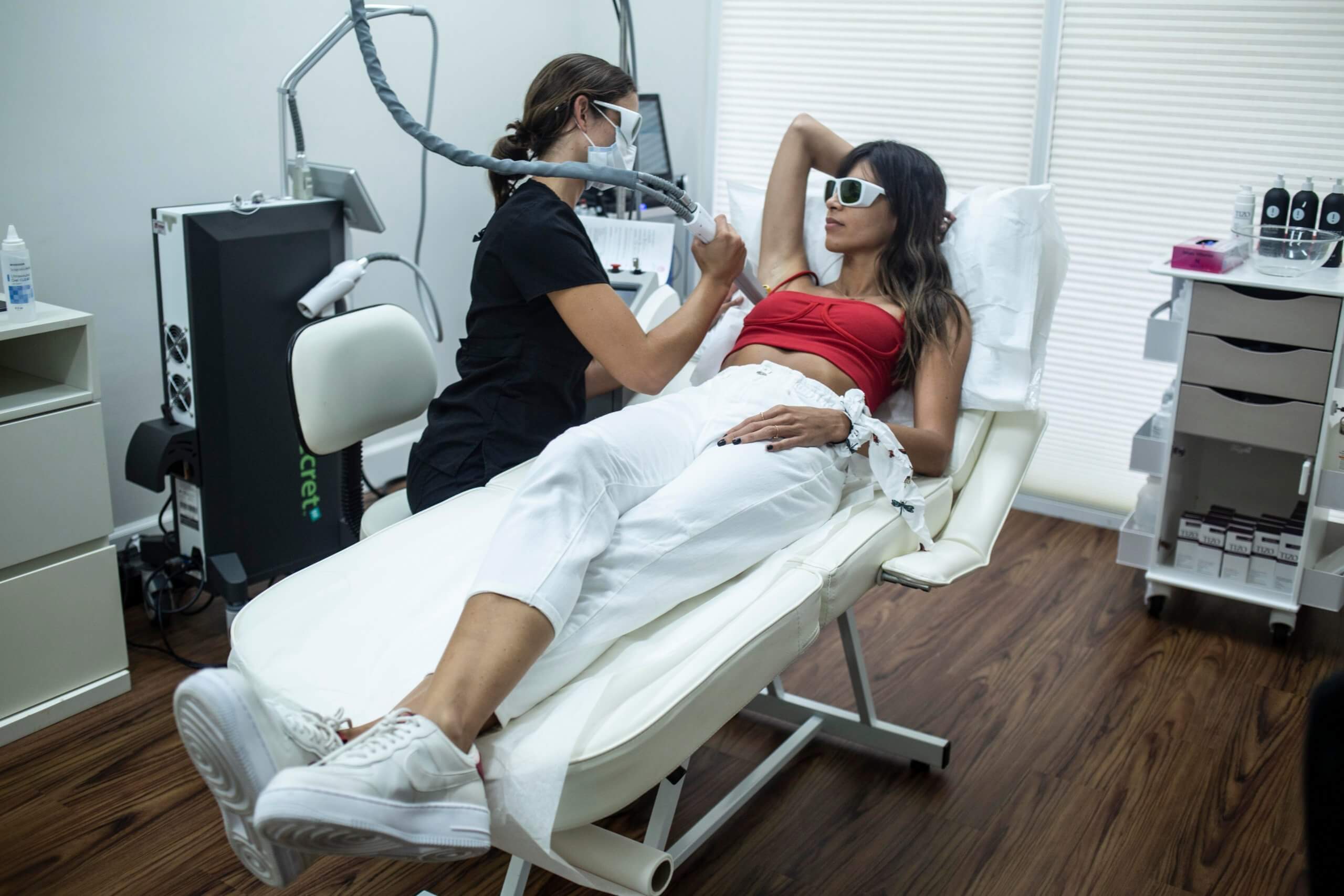


What a laser hair removal session looks like
Everything you'd ask at the consult
Light energy, absorbed at the follicle
The process is quite simple — a very short pulse of laser energy is absorbed by the melanin, or pigment, in the hair, damaging the follicles that lie beneath the skin so future growth is reduced, while the surrounding skin is spared.
Not all follicles have hair growing at the same time. The laser can only damage follicles in their active growth phase, which is why sessions are spaced about 4 to 8 weeks apart, set by the area, and most plans run 6 to 8 sessions.
Two platforms, matched to your skin
At Miami Skin Spa we use Diolaze by InMode and excel HR by Cutera. Having both an Nd:YAG-based system and a diode-based system lets us match the device to your skin tone, hair texture, and treatment area — more comfortable sessions and more efficient results than any single platform allows, with the wavelength matched to your skin tone after Fitzpatrick typing. It also helps prevent the razor burn, razor cuts, and ingrown hairs (pseudofolliculitis barbae) that come with shaving and waxing.
Brazilian & bikini laser hair removal
Brazilian laser hair removal is one of our most requested treatments. A full Brazilian — complete coverage of the bikini area, front to back — usually takes about 30 minutes per session. The skin here is sensitive and often deeper in tone than surrounding areas, so device selection matters: this is exactly where having both a diode and an Nd:YAG platform pays off.
Face, underarms, legs, back & chest
We treat the face (upper lip, chin, and jawline), underarms, bikini line and Brazilian, legs, back and chest, and arms and hands — plus the abdomen, neck, and shoulders. Underarm and facial treatments are favorites for ending the daily shave-and-irritate cycle that leaves dark spots and shadowing behind.
How long each area takes
- Full face: 15 minutes · hands: under 15 · underarms, neck, or shoulders: about 15 each.
- Brazilian bikini, chest, or abdomen: about 30 minutes each.
- Full arms: 30 minutes (upper or lower arms alone, about 15).
- Full legs or the whole back: 45 minutes (upper or lower portions, under 30).
Full body laser hair removal
Full body laser hair removal is planned patient-by-patient. Treating many areas at once lowers the overall cost — you don't pay the total of all individual areas; we package them together and add additional discounts.
excel HR by Cutera — Nd:YAG + Alexandrite
The excel HR combines the 1064 nm Nd:YAG with a 755 nm Alexandrite laser in one FDA-cleared platform, used across a wide range of skin tones and hair colors. Its sapphire contact cooling keeps the skin cool during each pulse.
Diolaze by InMode — high-powered diode
Diolaze is a high-powered diode laser, generating energy at around 800–810 nm with pulse durations long enough to be fully absorbed by the skin — ideal for darker, coarser hair and larger body areas like the back or legs.
The wider device landscape
- Ruby laser (694 nm) — the oldest type; only suits fine skin with lighter hair.
- Alexandrite laser (755 nm) — fast over large areas with ultra-short pulses, but standalone systems bring more discomfort and side effects such as blistering or hyperpigmentation.
- Diode laser (800–810 nm) — the modern workhorse for darker, coarser hair; Diolaze's technology.
- Nd:YAG laser (1064 nm) — used across a wide range of skin tones and hair types; the excel HR pairs it with a 755 nm Alexandrite in one platform.
What about IPL hair removal?
IPL — "intense pulsed light" — combines different wavelengths into a broad spectrum rather than a single focused beam, so the energy scatters: gentler, but less precise. It's also used for age spots, facial flushing, and rosacea, and most patients need six to eight IPL sessions before seeing permanent hair reduction. Lasers are more direct, so overall light exposure is lower — and the excel HR is very comfortable for most patients, while IPL is generally less comfortable than contact-cooled lasers. See our dedicated IPL service page.
How many sessions you'll need
The minimum is usually 6 treatments, some patients need up to 12, and most people need about 6–8 total sessions. After the initial session, most patients see about a 25% reduction in total hair volume — and any hair that remains or regrows is lighter in texture and color. Patients with hormone disorders such as Polycystic Ovarian Syndrome may not see the same level of reduction and sometimes need additional sessions or maintenance.
Spacing between sessions
Sessions are spaced about 4 to 8 weeks apart, set by the area, and most plans run 6 to 8 sessions — so a full course can take the better part of a year. The exact spacing is set by our nurse practitioner at your consultation.
How long results last
Permanent hair reduction is defined as a long-term, stable reduction in hair counts observed at 6, 9, and 12 month intervals after all treatment sessions. Many patients see little to no regrowth for years; thicker hair may see a high-but-not-total reduction, addressed with touch-ups every 6–12 months at a highly discounted price. Hormonal fluctuations, such as pregnancy, may promote new growth — treatment can resume once your maternity is over and you are no longer breastfeeding.
Laser hair removal for dark skin
A common misconception is that laser hair removal only works on some skin types. People with brown skin and people with black skin are great candidates: the combination of Diolaze by InMode and excel HR by Cutera lets us treat brown and black skin with the wavelength matched to your skin tone. The 1064 nm Nd:YAG wavelength bypasses much of the epidermal melanin — the standard of care for deeper skin tones, where the wrong wavelength carries a real risk of post-inflammatory hyperpigmentation.
How we match the laser to your skin
In your free consultation, our nurse practitioners use the Fitzpatrick Scale to categorize your skin type, then customize the treatment to you. Pigment-reactive skin — including patients managing melasma — gets conservative settings and the wavelength least likely to disturb surrounding pigment. The treatment works best with contrast between skin and hair color: ideal hair is dark and coarse, while fine blonde or grey hair on very light skin may not always respond fully regardless of which laser or IPL unit is used.
What rules a patient out is a specific medical reason, not skin color — and those are always discussed by our nurses during the consultation.
Is laser hair removal safe?
When performed by licensed providers with medical-grade equipment, yes. At-home devices are lower-powered and are not a substitute for medically supervised treatment. At Miami Skin Spa, each of our nurses is first trained for laser safety, then trained on each manufacturer's device. You'll wear laser safety goggles during treatment, and the excel HR's sapphire contact cooling plus a targeting gel protects the skin from over- or under-treatment. Laser hair removal is a medical procedure, and every medical procedure has risks — thoroughly discussed at the consultation, and at worst involving blistering.
How to prepare
- Shave the area 1–2 days before — at least 24 hours ahead. Do not wax, pluck, or tweeze between treatments.
- No creams or oils on treatment day; skip spray tans and sunless tanning products.
- Avoid sun exposure and tanning beds for at least 1 week before — ideally two. If your skin is burnt or tan, wait until it subsides; treatment on tanned skin is possible but more uncomfortable.
- We do not treat patients who have taken Accutane in the past 6 months; photosensitizers — Tazorac, other strong anti-acne medicines, recent chemical peels — should be discussed first.
- Anticoagulants may increase the risk of purpura or bruising.
Does it hurt?
Most patients don't describe it as painful — it feels like a rubber band being flicked against your skin repetitively. The darker and coarser the hair, the more sensation you'll feel, because darker hair absorbs more energy — but those patients also see results faster and need fewer treatments. Both Diolaze and excel HR keep the skin cool throughout, with no downtime.
Right after your session
There is no required downtime — all normal activities may be resumed right after treatment as long as the skin is protected from UV light. Redness and perifollicular edema are common, typically last only a few hours, and are usually gone within 12–24 hours; icing the area diminishes any discomfort. Bruising and swelling are uncommon and resolve on their own.
The first weeks
- Avoid sun exposure for up to three weeks after treatment; use a broad-spectrum (UVA/UVB) sunscreen on the treated area.
- Avoid heat — hot tubs, saunas — for 1–2 days, and skin irritants for a few days.
- Hair may take up to two weeks to fall out. You can shave once the skin settles, but do not pinch, pop, wax, or tweeze the targeted areas.
Temporary skin lightening or darkening can occur, most commonly in naturally dark skin or with continued sun exposure — one more reason daily SPF is non-negotiable while you work toward smooth, even-toned skin.
What we pair it with
Hair removal is often the first step in a broader smooth-skin plan. Our team may recommend pairing it with:
- Lasers for the body — IPL, Pico, and Laser Genesis protocols for the discoloration and texture that years of shaving leave behind.
- Facial laser treatments — for facial pigment or resurfacing rather than hair, a different toolkit.
- Forma — needle-free radiofrequency skin tightening in the same areas you're clearing of hair.
- HydraFacial — keeps facial skin clear and calm between facial sessions.
Sequencing matters — laser hair removal and photosensitizing treatments like peels need spacing. Your plan is built at the consultation.
Not sure which laser is right? Bring your concern, not a treatment name. If it's unwanted hair, we'll match you to Diolaze or excel HR; if it's pigment, tone, or texture, our facial laser and body laser teams own that toolkit.
Laser hair removal cost in Miami
Single sessions run $100–$350 per area; the total depends on the number of treatments, area size, skin type, and difficulty. Every quote is confirmed at a free consultation with free on-site parking. Full details on the pricing page.
| Area | Single session | Package of 6 (25% off) |
|---|---|---|
| Upper lip or chin | $100 | $450 |
| Underarms | $150 | $650 |
| Bikini | $150 | $650 |
| Brazilian | $200 | $900 |
| Upper or lower arm / leg | $250 | $1,100 |
| Full arms or full legs | $350 | $1,500 |
Laser hair removal is a one-time series rather than a recurring cost. To make starting easy, we offer interest-free financing via CareCredit over 6, 12, or 18 months — and we use FDA-cleared platforms, because lower-powered devices typically require more sessions to reach the same endpoint. For perspective, as Rebecca M. Herzig documents in Plucked: A History of Hair Removal, the average woman who shaves spends more than $10,000 — and nearly two months of her life — managing unwanted hair, while a regular waxer spends more than $23,000 over a lifetime.
Laser vs IPL, waxing & shaving
Both IPL and lasers use light to heat hair follicles until they're damaged and stop regrowing — but the delivery, precision, and long-term math differ a lot.
| Method | How it works | Longevity | Comfort & trade-offs |
|---|---|---|---|
| Laser hair removal | Single focused wavelength, matched to your skin and hair, with contact cooling | Permanent hair reduction after 6–8 sessions | Light rubber-band snaps; very comfortable for most patients |
| IPL hair removal | Broad spectrum of scattered light wavelengths | Permanent hair reduction after roughly 6–8 sessions | Gentle, but generally less comfortable than contact-cooled lasers |
| Waxing | Pulls hair from the follicle with wax and strips | 2–4 weeks, for as long as you keep waxing | Painful; lifetime cost over $23,000; frequent ingrown hairs |
| Shaving | Cuts hair at the skin surface | 1–3 days, for as long as you keep shaving | Razor burn, cuts, ingrown hairs; over $10,000 lifetime |
Why not just continue shaving? The average person uses 7,848 gallons of water shaving each year and spends over 130 minutes a month on it — the average woman shaves almost 8,000 times across roughly 50 years, about 60 days of her life. Six to eight laser sessions replace that entire cycle while reducing hair growth long-term. The only catch: it can't be done in one session — not every follicle has hair in it at any given moment, so sessions are spaced about 4 to 8 weeks apart, set by the area, and most plans run 6 to 8 sessions.
Why our Brickell laser team
Each of our nurses is trained for laser safety and then on each manufacturer's device — and we only recommend a treatment series when your consultation shows you're a strong candidate. Our Brickell practice has served more than 10,000 patients.
Morgan Winters, FNP-C
Family Nurse Practitioner specializing in laser treatments and skin-health planning. Morgan performs your Fitzpatrick assessment, selects the platform, and tunes settings to your skin at every visit.
Meet Morgan →A licensed medical team
Every laser treatment is performed by a licensed medical provider after an individual evaluation. The same team handles your touch-ups, so your settings history travels with you.
Meet the whole team →Start from your concern
Shaving and waxing leave irritation, shadowing, and pigment behind. Each guide covers the adjacent concern in depth.
Ingrown hairs & breakouts
Pseudofolliculitis barbae and razor bumps — why removing hair at the follicle ends the cycle.
Read the guide →Hyperpigmentation
How wavelength choice protects deeper skin tones from post-inflammatory pigment.
Read the guide →Dark spots & shadowing
Underarm and bikini-line shadowing from shaving — what fades it once the hair is gone.
Read the guide →Melasma
Heat- and light-sensitive pigment needs careful device selection for facial treatments.
Read the guide →Sun damage
Miami sun and lasers need choreography — sun rules before and after treatment.
Read the guide →From the blog
Laser hair removal vs. waxing vs. shaving
The full comparison — cost, pain, longevity, and which method wins long-term.
Read →Brazilian laser hair removal: a complete guide
What full Brazilian treatment includes, session by session. Coming soon.
Coming soon →Laser hair removal for dark skin
Why Nd:YAG changed everything for deeper skin tones. Coming soon.
Coming soon →How to prepare for laser hair removal
The shave-don't-wax rule, sun timing, and medication checklist. Coming soon.
Coming soon →Frequently asked questions
Most patients need between 6–8 sessions for optimal, permanent hair reduction. Some — especially those with thicker hair or hormonal conditions such as Polycystic Ovarian Syndrome — may need up to 12, plus occasional maintenance.
You may feel mild discomfort similar to a light snap, but both Diolaze and excel HR include cooling features that help keep treatment comfortable. Most patients tolerate it very well.
Having both systems allows us to tailor treatment to your skin color, hair type, and body area. That flexibility lets us match the device and settings to a wide range of skin tones.
Having both Diolaze by InMode and excel HR by Cutera lets us treat a wide range of skin tones, including deeper complexions. Your provider types your skin on the Fitzpatrick Scale and matches the wavelength and settings to it at the consultation.
Session length depends on the treatment area — from a few minutes for small areas like the upper lip to about an hour for legs or back. A full face takes about 15 minutes; a Brazilian about 30.
Shave the area to be treated 24 hours before your appointment and avoid sun exposure in the days leading up to your session. Skip creams, oils, and self-tanner on treatment day, and don't wax or pluck between sessions.
Hair reduction typically becomes noticeable after 2–3 sessions, with full results achieved after completing the recommended treatment course. Treated hair sheds over the first two weeks, and most patients see about a 25% reduction after the first session.
Single sessions at Miami Skin Spa run $100–$350 per area — from $100 for the upper lip or chin to $350 for full legs or full arms — with packages of 4, 6, or 10 sessions discounted 15–35%. Your exact quote comes from a free consultation. See current pricing.
Yes — full Brazilian laser hair removal is one of our most requested treatments. Sessions take about 30 minutes, start at $200, and package pricing brings the per-session cost down significantly.
Yes. Full body laser hair removal is priced on a patient-by-patient basis — treating many areas at once is faster, so we package areas together and add additional discounts rather than charging the sum of individual areas.
Permanent hair reduction means a long-term, stable reduction in hair counts at 6, 9, and 12 months after your series. Many patients see little to no regrowth for years; any regrowth is handled with discounted touch-ups every 6–12 months.
Yes — current specials include full legs at $1,500 for six sessions (a $600 savings), and bundling two areas takes an extra 10% off. See the pricing page.
Ready to retire the razor?
Book a free consultation in Brickell. We'll type your skin on the Fitzpatrick Scale, match you to Diolaze or excel HR, and hand you a written plan with exact per-area pricing. Patients come to us for laser hair removal from across the Miami area, including Miami Beach, Coral Gables, and Miami Lakes.
Miami Skin Spa · Brickell · 1501 South Miami Avenue #201, Miami, FL 33129 · 305-557-1615
Sources
- American Academy of Dermatology — Laser hair removal FAQs: candidacy and expected reduction per session. https://www.aad.org/public/cosmetic/hair-removal/laser-hair-removal-faqs
- American Academy of Dermatology — 6 ways to remove unwanted hair: dermatologist consumer guidance on laser hair removal and at-home device risks. https://www.aad.org/public/everyday-care/hair-scalp-care/hair/remove-unwanted-hair
- StatPearls (NCBI Bookshelf) — Laser Hair Removal: selective photothermolysis, wavelength selection by Fitzpatrick skin type, complications. 2023. https://www.ncbi.nlm.nih.gov/books/NBK507861/
- InMode — DiolazeXL diode laser hair removal platform: manufacturer clinical overview. https://www.inmodemd.co.uk/diolazexl/
- Cutera — excel HR: 1064 nm Nd:YAG + 755 nm Alexandrite platform with sapphire contact cooling. Manufacturer overview. https://www.cutera.com/
- Herzig, Rebecca M. — Plucked: A History of Hair Removal (NYU Press, 2015): lifetime cost data for shaving and waxing. https://nyupress.org/9781479816873/plucked/